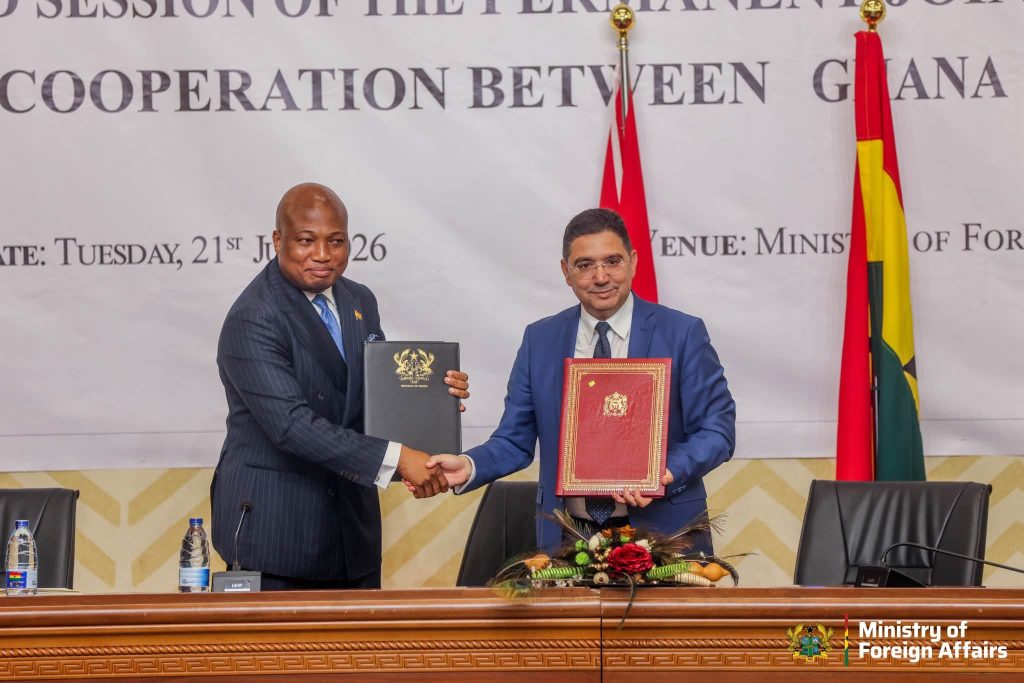
Ghana and Morocco have signed 11 bilateral agreements to deepen cooperation across key sectors. These agreements, signed on Tuesday, July 21, 2026, aim to expand collaboration in areas such as air transport, customs, education, science, mining, and vocational training. The signing took place at the Ministry of Foreign Affairs in Accra during the Ministerial Session of the Second Permanent Joint Commission for Cooperation (PJCC).
The agreements are expected to strengthen institutional ties between Ghana and Morocco. They will also create new avenues for technical cooperation, skills development, knowledge exchange, and economic collaboration. This comprehensive partnership seeks to foster mutual growth and development across both nations.
This initiative aligns with Ghana's broader strategy to diversify its international partnerships and attract foreign investment. Ghana has actively sought to open its mining and agriculture frontiers to investors, as seen in recent engagements with Saudi investors. Strengthening ties with Morocco, a significant African economy, supports Ghana's push for greater economic integration and collective self-reliance on the continent.
Ghana’s Minister for Foreign Affairs, Samuel Okudzeto Ablakwa, and Morocco’s Minister of Foreign Affairs, African Cooperation and Moroccan Expatriates, Nasser Bourita, co-chaired the session. Both ministers reaffirmed their commitment to ensuring the effective implementation of the decisions and agreements reached. They expressed confidence that the expanded cooperation would deepen Ghana-Morocco relations.
Among the signed deals is an Agreement on Air Services, initially agreed upon in December 2022. Another significant agreement is on Mutual Administrative Assistance in Customs Matters, which will strengthen cooperation between the customs authorities of both countries. These measures are crucial for streamlining trade and improving border efficiency.
A Memorandum of Understanding (MoU) on standardisation, conformity assessment, and metrology-related activities was also signed. This MoU covers areas critical to trade, product standards, and industrial development, ensuring that goods traded between the two countries meet international benchmarks. Such agreements are vital for facilitating smoother commercial exchanges.
Cooperation will also extend to higher education, scientific, and technological research through a dedicated MoU. This partnership aims to foster academic exchanges and collaborative research projects. Additionally, an agreement was signed to promote collaborative activities in meteorology and climatology, addressing shared environmental challenges.
In the mining and geological sector, an MoU provides for scientific and technical cooperation. This involves Morocco’s Office National des Hydrocarbures et des Mines (ONHYM), Ghana’s Minerals Commission, and the Ghana Geological Survey Authority. This collaboration will enhance expertise and resource management in a vital economic sector for Ghana.
Further agreements cover diplomatic training and vocational training, opening opportunities for skills development and institutional capacity building. These initiatives are designed to improve human capital and strengthen public sector capabilities. Another Cooperation Agreement focuses on academic scholarships, internships, and the sharing of expertise, benefiting students and professionals.
The remaining agreements broaden the partnership into areas of cultural and institutional cooperation, specifically focusing on sports and archives. These diverse agreements underscore a comprehensive approach to bilateral relations. The Ministerial Session followed a Technical Experts Meeting held in Rabat from June 9 to 11, 2026, where officials prepared the groundwork for these agreements.
The 11 agreements mark a significant expansion of the bilateral partnership, moving it beyond traditional diplomatic relations. This shift towards practical cooperation in sectors with direct implications for trade, education, skills development, scientific research, and economic growth is noteworthy. The effective implementation of these agreements will be a key indicator of their success and impact on both economies.