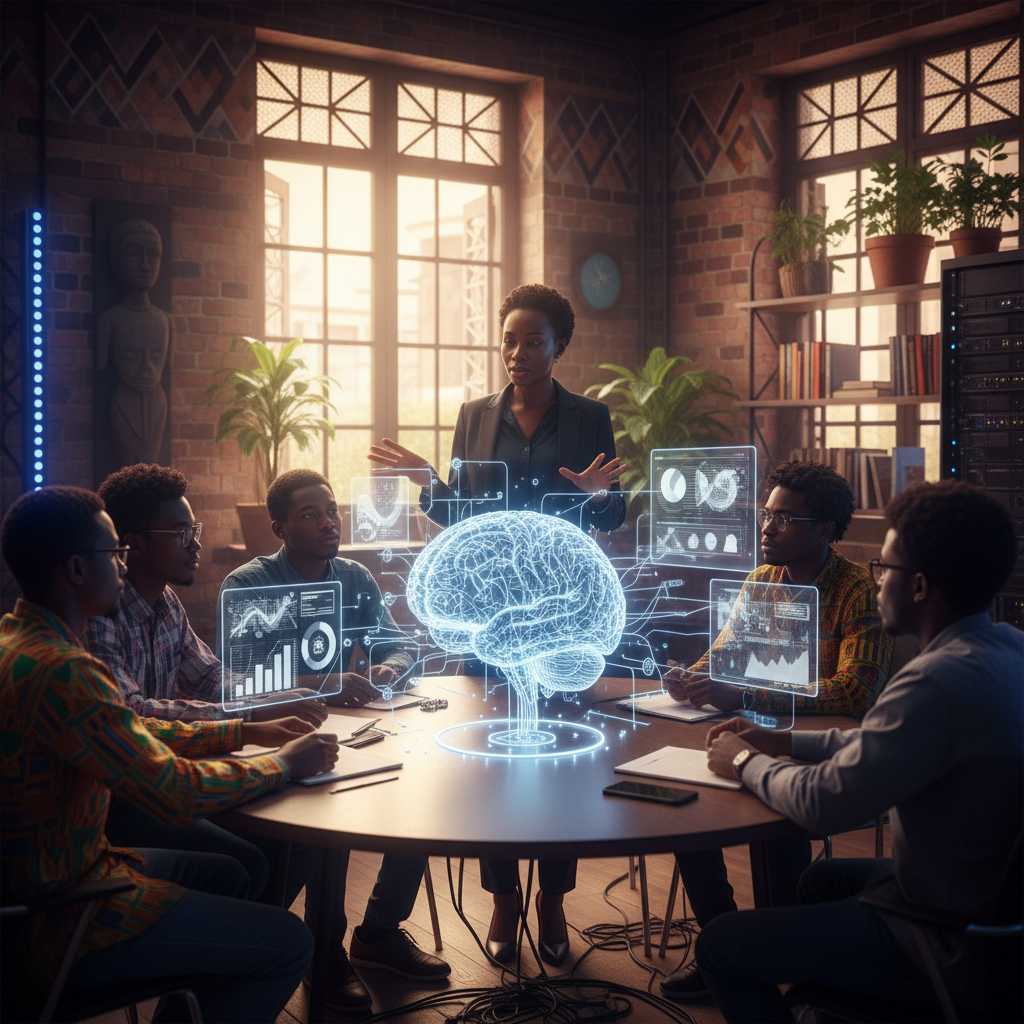
Kwesi Amoafo-Yeboah states that "Artificial Intelligence" is a misleading term. He proposes that intelligence is not exclusively human but a natural phenomenon. This perspective challenges long-held assumptions about intelligent behavior.
Intelligence emerges wherever data can be acquired, stored, analyzed, and applied. Amoafo-Yeboah argues that intelligence existed in nature long before computers. For example, a plant turns towards sunlight, and bird migrations show remarkable precision. An ant colony coordinates labor without a central leader. These natural systems demonstrate learning and adaptation.
This redefinition fits into a broader understanding of how systems in Ghana and globally operate. Understanding intelligence as universal, not just human, can inform policy and innovation. It suggests that economic systems, organizations, and even markets display intelligence through their adaptive behavior. Such an understanding supports the growth of Ghana's technology and digital economy sectors.
Kwesi Amoafo-Yeboah, Chairman of iZone Limited, Dodo Technologies Limited, and BlueCloud Networks Limited, articulated this view on June 9, 2026, as reported by JoyBiz. He highlights that the term "Artificial Intelligence" arose from the historical need to name machines that mimicked human reasoning. He suggests that if intelligence were inherent to machines, it would not be called "artificial" but simply a different type of intelligence.
This revised understanding implies future shifts in how we develop and interact with technology. Decision-makers and markets will need to acknowledge intelligence in diverse forms. Ghanaian businesses might explore new applications of computational intelligence, moving beyond human-centric design. This shift could lead to more efficient systems in various sectors.
The concept of intelligence is further broken down into four core elements. These elements are information, memory, feedback, and adaptation. Any system that observes its environment, remembers past events, learns from results, and adjusts its behavior exhibits intelligence. This applies to organisms, organizations, economies, and machines alike.
Historically, humanity has viewed intelligence as a property of individuals. However, civilizations advanced not because individuals became smarter. Instead, societies learned to preserve and transfer knowledge across generations. Modern progress relies on accumulated experience from millennia, not just individual brilliance. This collective intelligence is a powerful driver.
This viewpoint challenges the persistent human tendency to redefine intelligence whenever machines surpass human capabilities. When calculators excelled at arithmetic, humans decided arithmetic was not true intelligence. When computers mastered chess, chess was deemed not truly intelligent. The goalposts keep moving as machines improve in areas like pattern recognition, language, and diagnostics. The true question may be humanity's willingness to recognize intelligence in forms different from themselves.