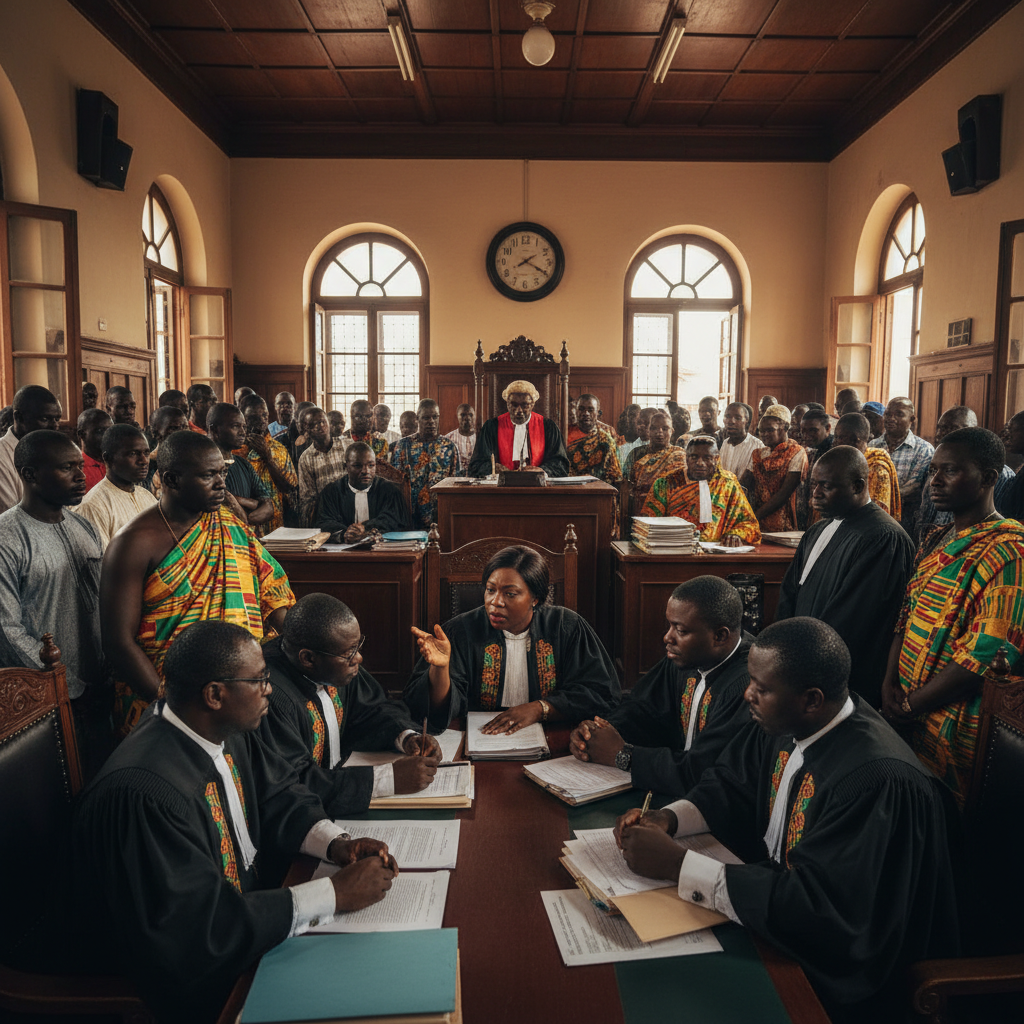
The Supreme Court of Ghana will issue its judgment on July 29, 2026, in a significant lawsuit challenging the delegate system used by political parties. This system chooses party leaders and presidential candidates. The case was initiated by former Minister for Environment, Science, Technology and Innovation, Prof. Kwabena Frimpong-Boateng. Dr. Nyaho Nyaho-Tamakloe and Dr. Christine Amoako-Nuamah joined him in this legal action.
The lawsuit targets the delegate-based electoral college system prevalent in major Ghanaian political parties. These parties include the New Patriotic Party (NPP), the National Democratic Congress (NDC), and the Convention People's Party (CPP). The plaintiffs argue that this system limits voting rights to a small group of party officials and selected delegates. This effectively excludes most party members from choosing presidential and parliamentary candidates.
This legal challenge fits into a broader discourse on democratic governance and political party reform in Ghana. Concerns about internal party democracy have been ongoing, with many advocating for greater member participation. The current system has often been criticized for creating an elite group of voters, which some perceive as undemocratic. This case highlights a persistent tension between established party structures and calls for a more inclusive political process.
Represented by lawyer Oliver Barker-Vormawor, the plaintiffs assert that political parties must operate democratically. They contend that the delegate system violates principles of equality and participation enshrined in the 1992 Constitution. The Electoral Commission (EC) has also been named in the suit. Plaintiffs accuse the EC of not enforcing the Political Parties Act, which requires parties to maintain democratic internal structures. The Supreme Court's decision will likely clarify the extent to which the EC can intervene in party affairs.
The plaintiffs seek several outcomes from the court. They want a declaration that the delegate systems of the NPP, NDC, and CPP are unconstitutional. They also request an order compelling these parties to amend their constitutions to allow all members in good standing to vote directly. Additionally, they seek a directive for the Electoral Commission to review party constitutions for democratic compliance. They are also asking for a declaration affirming equal voting rights for all party members.
The Supreme Court's ruling will have substantial implications for political parties across Ghana. It could force a fundamental re-evaluation of how parties select their candidates and leaders. A decision in favor of the plaintiffs would likely lead to significant overhauls in party constitutions and internal election processes. This could empower ordinary party members and fundamentally reshape Ghana's political landscape. Market observers will watch how this decision influences political stability and electoral outcomes in future national elections.