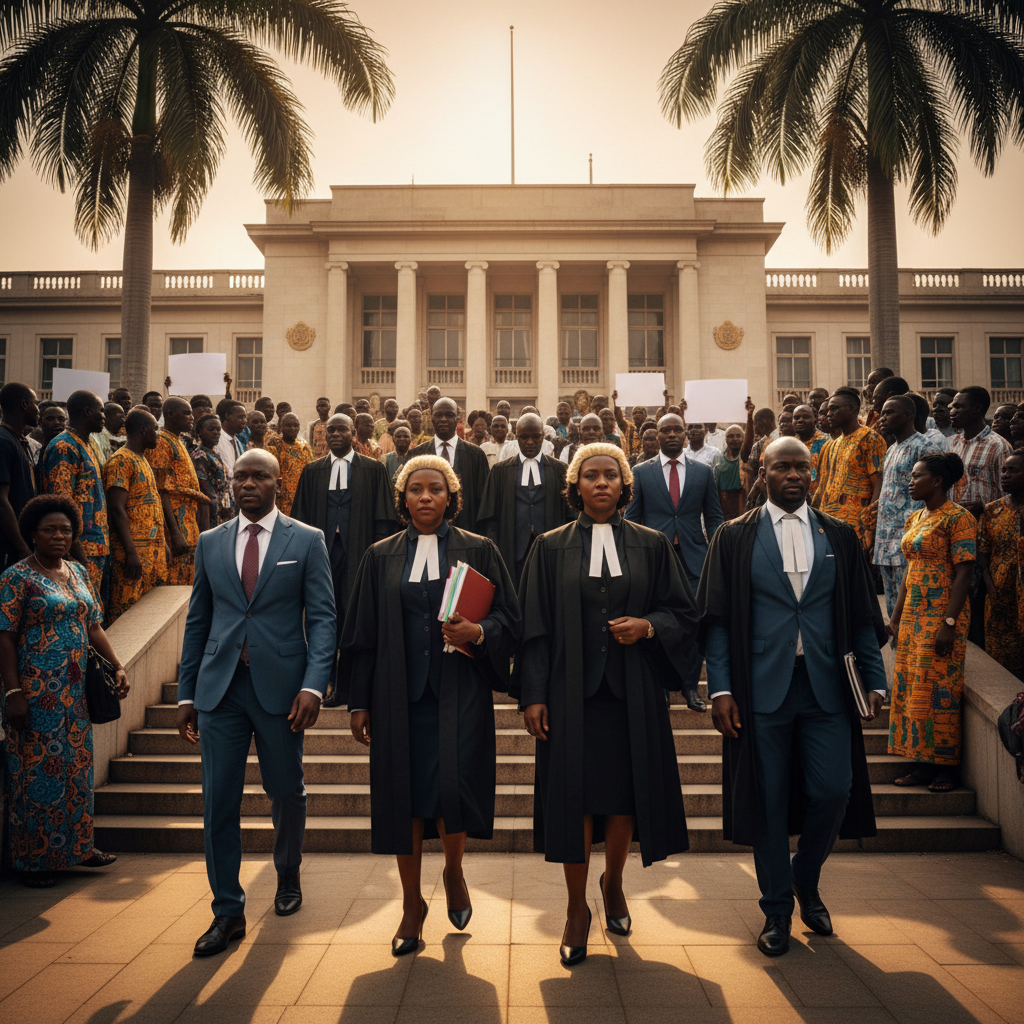
Ghana's Supreme Court has begun proceedings in a landmark constitutional case challenging the prosecutorial powers of the Office of the Special Prosecutor (OSP). The Deputy Attorney-General, Dr Justice Srem-Sai, and 14 Civil Society Organisations (CSOs) appeared for this significant hearing. The court will determine if Parliament acted unconstitutionally by granting the OSP independent prosecutorial authority.
This case stems from a suit filed on December 12, 2025, by private legal practitioner Noah Ephraem Tetteh Adamtey. Mr Adamtey argues that Parliament exceeded its constitutional mandate by creating an office with independent prosecutorial powers. He contends that Articles 88(3) and 88(4) of the Constitution vest prosecutorial authority solely in the Attorney-General.
The Attorney-General's office has taken an unusual stance, effectively aligning with the plaintiff. In its draft statement of case, the Attorney-General argues that Article 88(3) of the 1992 Constitution solely vests prosecutorial powers in that office. It further contends that Parliament acted unconstitutionally by passing the OSP Act, 2017 (Act 959). This Act made it compulsory for the Attorney-General to delegate part of its prosecutorial powers to the OSP. This challenge comes amid ongoing debates about the independence and effectiveness of anti-corruption institutions in Ghana.
Dr Srem-Sai has previously stated that granting full prosecutorial independence to the OSP would require a constitutional amendment. He explained, "If you want the OSP to be independent of the Attorney General and would not require the Attorney General's authorisation, then you need to amend Article 88." This underscores the Attorney-General's position that the current legal framework does not support the OSP's independent prosecution powers.
A seven-member panel of the Supreme Court, chaired by Chief Justice Paul Baffoe-Bonnie, granted permission for 14 CSOs to join the case as amicus curiae, or "friends of the court." These organisations include prominent bodies such as the Ghana Centre for Democratic Development (CDD-Ghana) and IMANI Africa. They stated their involvement aims to support constitutional interpretation and uphold institutional integrity. Their expertise in governance and anti-corruption advocacy will assist the court in its deliberations.
The OSP itself has been excluded from the proceedings. The Supreme Court dismissed its application to be joined as a party. The court ruled that the OSP was not a necessary party and that the issues could be determined without its participation. This decision maintains focus on the constitutional interpretation of prosecutorial powers rather than the OSP's operational mandate.
This case carries significant implications for Ghana's anti-corruption framework. A High Court decision on April 15, 2026, already ruled that the OSP cannot independently prosecute criminal cases without the Attorney-General’s authorisation. That ruling directed all existing OSP prosecutions to transfer to the Attorney-General. The Supreme Court's decision will either affirm or overturn this High Court ruling. This will define the scope of the OSP's powers and its ability to combat corruption effectively. Observers will closely watch the court's judgment for its impact on future anti-corruption efforts and the balance of power between key state institutions.