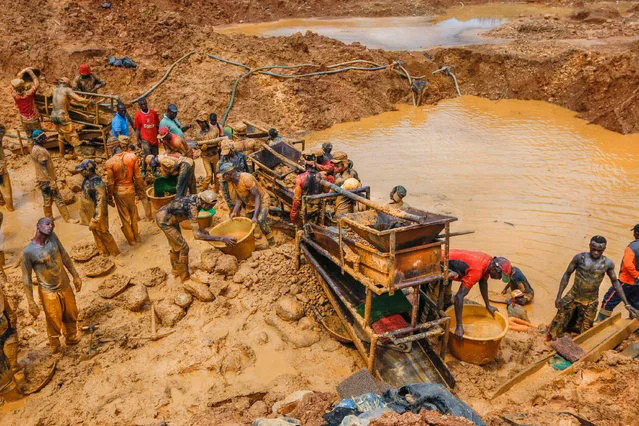
Ghana is failing in its fight against illegal small-scale mining, known as galamsey, despite years of government interventions. Senyo Hosi, a prominent advocate against galamsey, stated that the country is moving backwards, with water quality deteriorating significantly.
The number of people involved in illegal mining has surged dramatically over the past two years. In August 2024, an estimated 14,000 to 14,500 individuals engaged in galamsey. By August 2025, this figure reportedly rose to about 98,000, indicating an exponential increase.
This worsening situation highlights a critical challenge within Ghana's economic and environmental landscape. Galamsey not only degrades vital water bodies and forest reserves but also threatens food quality and national security. The persistent failure to curb illegal mining impacts public health and the long-term sustainability of natural resources, which are crucial for economic development.
Mr. Hosi, Convener of the OneGhana Movement, emphasized that success should be measured by environmental improvements, not just arrests. He stated, "We are nowhere near winning the fight against galamsey. We are nowhere near winning at all, and it is fair that we say we have failed in that fight."
The implications are significant for Ghana's future and policy direction. Decision-makers must rethink the current anti-galamsey strategy, focusing on tangible outcomes like reduced water turbidity. Policymakers should publish relevant data to allow independent assessment of intervention effectiveness. This shift towards data-driven policy is essential for restoring degraded environments and safeguarding public health.
The current approach, which heavily focuses on arrests and equipment destruction, has not yielded desired results. Mr. Hosi argued that such enforcement activities are not sufficient benchmarks for success. He questioned the value of arrests if water quality continues to decline. This perspective calls for a fundamental re-evaluation of resource allocation and strategic priorities in the anti-galamsey campaign.
Ghana missed a crucial opportunity during the first term of former President Nana Akufo-Addo to decisively tackle the galamsey menace. This historical context underscores the urgency of the current situation. The continued degradation of natural resources poses a severe threat to agricultural productivity and the overall well-being of communities dependent on clean water.
The economic costs associated with galamsey are substantial, including expenses for water treatment and healthcare for affected populations. The loss of biodiversity and the destruction of arable land further compound these economic burdens. Effective policy must consider these broader economic impacts.
Greater transparency and rigorous evaluation of all anti-galamsey interventions are now imperative. The government must demonstrate the real impact of its efforts rather than just highlighting operational statistics. This accountability is vital for regaining public trust and ensuring that future policies are genuinely effective.
The call for data publication would enable independent bodies and citizens to monitor progress. This transparency is a cornerstone of good governance and effective public policy. Without clear, measurable outcomes, interventions risk becoming costly exercises with little lasting benefit.
Ultimately, the fight against galamsey requires a comprehensive strategy that prioritizes environmental restoration and community engagement. The current trajectory suggests that without a significant policy shift, Ghana's natural resources will continue to suffer. This situation demands immediate and decisive action from all stakeholders.