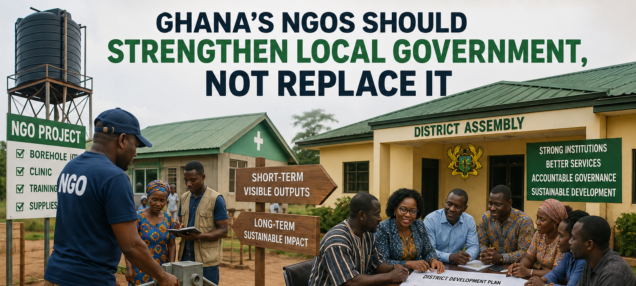
Ghanaian non-governmental organisations (NGOs) must prioritise strengthening local government institutions rather than replacing them. This strategic shift is crucial for ensuring the long-term sustainability of development projects across the nation.
Many development initiatives, while delivering immediate results like boreholes or clinics, often fail when donor funding ends. This happens because local institutions lack the capacity or resources to maintain these services. The current approach risks undermining public service delivery and democratic accountability in the long run.
This concern fits into Ghana's broader economic and political narrative of improving public sector efficacy. The Medium-Term National Development Policy Framework for 2026–2029 identifies accountable governance as a national priority. Weak institutional frameworks can hinder sustainable development and efficient resource allocation, impacting economic growth.
The Ghana Report states that NGOs' greater contribution lies in strengthening public institutions that will remain after donor funding departs. This ensures citizens depend on elected local government for public services, not unelected organisations. For example, UNICEF helped scale up integrated social services from 170 to 180 districts in 2024.
The implications are significant for Ghana's development trajectory and public finance. Without proper integration, valuable resources invested in NGO projects may not yield lasting benefits. Decision-makers must ensure that NGO interventions build local capacity, not create parallel systems.
The current model often sees NGOs creating separate databases or providing equipment without maintenance budgets. This institutional substitution weakens existing public structures. Research on decentralisation in northern Ghana shows that strengthening civil society without linking to local government can weaken decentralisation efforts.
The Auditor-General’s report on 2024 district assembly accounts revealed recurring financial and administrative irregularities. These issues are partly due to officials' limited commitment to enforcing rules and a lack of sanctions. This highlights the existing institutional weaknesses that NGOs should aim to address, not bypass.
A Ghanaian study on decentralisation found citizens were satisfied with some services. However, central government control continued to weaken the effectiveness of decentralisation. This suggests a need for stronger local autonomy and capacity, which NGOs could help build.
Evidence from Volta Region health systems shows local service delivery depends on funding, financial capacity, and decision-making authority. It also relies on power relations among stakeholders and the broader political context. NGOs must consider these factors for their projects to succeed sustainably.
The problem arises when NGO projects appear effective in the short term but operate through parallel arrangements. These arrangements weaken rather than strengthen existing public institutions. For instance, providing equipment without assigning responsibility for its ongoing management creates future problems.
This is not a call for political interference in NGOs. It is also not an indictment of public officials alone. The goal is disciplined collaboration between NGOs and government. This collaboration ensures that development efforts are coordinated and sustainable.
Research on Ghana’s HIV/AIDS response found partnerships worked best with clear governance principles. These principles included strategic planning and competitive tendering. Dedicated funding mechanisms tailored to civil society engagement also proved effective.
Ghana’s pandemic response also showed a public agency and civil society could mobilise promptly. This happened when both understood their roles and mutual dependence. This demonstrates the potential for effective collaboration when roles are clear.
Four practical changes can move Ghana in this direction. First, each major NGO intervention needs a district partnership compact. This compact must link to the assembly’s medium-term development plan. It should specify responsibilities for finance, procurement, staffing, data, and maintenance.
The compact must also state when the project will close. If traditional authorities or community representatives play a material role, they should be party to this compact. This ensures local ownership and accountability from the outset.
Secondly, each assembly’s website should host a public digital register of NGO projects and donors. This register should record project location, target population, budget, and completion date. It should also name the responsible office.
This public data would help planners identify duplication and unserved communities. It would also let citizens know whom to ask if promises go unfulfilled. Published data would allow Parliament, media, and researchers to compare local needs against external resource targeting.
Third, donors must invest in capacity transfer as a concrete, verifiable outcome. This means more than a short workshop before an NGO’s departure. Named district staff should be trained to perform duties such as record-keeping and maintenance.
This approach ensures that local personnel gain the necessary skills to manage and sustain services. It transforms short-term interventions into long-term institutional strengths. This is vital for Ghana's continued development and economic stability.
Finally, this collaborative approach protects democratic accountability. It ensures that citizens are not forced to depend on permanent, unelected organisations for public services. Instead, they rely on their elected local government, strengthening the democratic process.