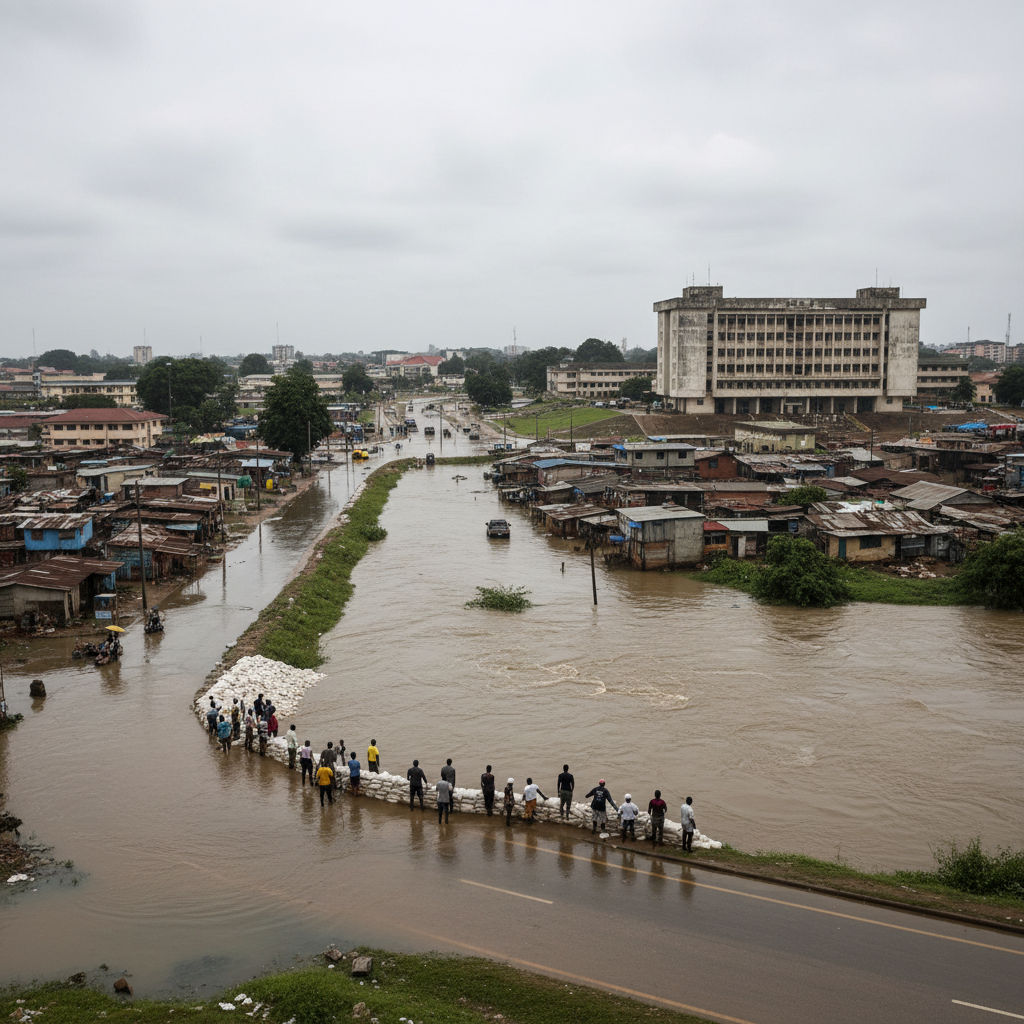
Professor Samuel Nii Ardey Codjoe, Pro-Vice-Chancellor of the University of Ghana, has called for a well-integrated risk management approach to address Ghana's perennial flooding problem. This new strategy aims to streamline efforts and improve national resilience against climate-related disasters.
The geographer and soil scientist stated this approach must cover safety awareness, evacuation protocols, and psychological support for flood victims. He noted the current institutional framework for flood management, from national to district levels, is overly complex and requires better coordination. This lack of cohesion hinders effective response and mitigation efforts across the country.
This call for action fits into Ghana's broader economic and social development challenges, where climate change impacts disproportionately affect vulnerable communities. Flooding disrupts agricultural cycles, damages infrastructure, and displaces thousands of people annually, costing the economy significant resources. For example, the Ghana Red Cross recently launched a GHS 8.3 million emergency flood response to assist 30,000 victims, highlighting the scale of the problem.
Professor Codjoe delivered his inaugural lecture as a full professor last Thursday, emphasizing the urgency of the situation. He stated, "Knowledge does not reside in laboratories and universities alone. It's not the prerogative of education holders." This highlights the importance of combining scientific research with local wisdom for effective solutions.
The implications are significant for Ghana's long-term economic stability and public health. A unified approach could reduce the GHS millions lost annually to flood damage and recovery efforts. Decision-makers must now consider how to integrate various agencies and local communities into a cohesive national strategy. This will require legislative changes and increased funding for disaster preparedness and climate adaptation.
Professor Codjoe, who oversees the university’s research, innovation, and development, stressed that Africa will likely experience more flooding in the coming years. This prediction demands Ghana's institutions work closely with local authorities in a coordinated fashion. He observed that the National Disaster Management Organisation (NADMO) appears overwhelmed by the current situation. A new approach is therefore critical for effective disaster response.
The population studies professor explained that yearly flooding results from multiple complex factors. These include residents building in environmentally sensitive areas and improper refuse disposal in gutters. These human activities exacerbate natural vulnerabilities, making communities more susceptible to flood impacts. Addressing these root causes is essential for any sustainable solution.
Professor Codjoe established that climate change is a major environmental and health challenge affecting livelihoods, food security, and well-being. His lecture examined the links between climate change, indigenous knowledge, disease patterns, and healthcare in Ghana. Effective adaptation requires integrating scientific evidence with local knowledge to strengthen climate monitoring and disease prevention.
He argued for a resilient health system capable of responding to climate-induced health crises. The professor noted that long before modern science, traditional people could read weather patterns and predict future events using natural signs. This indigenous knowledge offers valuable insights for contemporary flood management strategies. Collaboration between scientists and traditional rulers could unlock permanent solutions.
Dealing with the effects of climate change, a major contributor to flooding, the scholar also discussed architectural choices. He noted the shift from terracotta or ceramic roofing to colour-coated aluzinc contributes to increasing indoor heat. Professor Codjoe questioned the continued use of red roofing sheets instead of white or light-coloured roofs, which do not attract as much heat. Many Ghanaian rooms are sealed without proper ventilation, intensifying indoor heat.
He advised planting more trees and greens in homes to reduce the "baking heat" and provide shelter. This simple measure can ease heat conditions in homes and contribute to a cooler environment. Implementing such practical, community-level solutions alongside broader policy changes will be vital for Ghana's climate resilience. The proposed integrated approach offers a path towards a more secure future for Ghanaian communities.