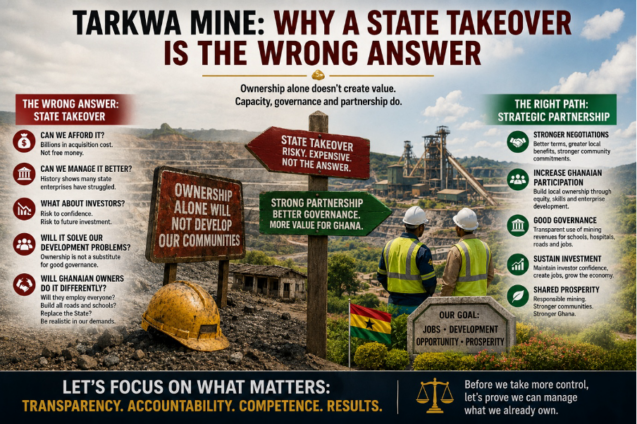
A proposal for the Government of Ghana to assume majority ownership of the Tarkwa Gold Mine after Gold Fields’ lease expires in 2027 has generated considerable public interest but faces significant criticism. Such a state takeover would require billions of dollars, potentially misusing the Heritage Fund, and risks undermining investor confidence in Ghana's mining sector. Experts argue that direct state ownership is unlikely to solve the long-standing development challenges in mining communities.
The Tarkwa Mine is one of Africa’s largest and most sophisticated gold operations, demanding decades of investment and complex engineering expertise. Acquiring majority ownership would necessitate billions of dollars, far beyond Ghana's current financial capacity without significant borrowing or repurposing strategic funds. Dr. David Agbee, a governance and international relations expert, initially proposed this idea, suggesting the use of the Heritage Fund, Stabilisation Fund, sovereign bonds, and concessional financing.
This proposal raises serious questions about Ghana’s economic priorities and fiscal prudence. The Heritage Fund, for instance, exists to preserve wealth for future generations, not to finance commercial asset acquisitions. Diverting these funds could deplete national savings meant for long-term stability. Ghana's broader economic narrative often involves balancing development needs with fiscal responsibility, and this proposal could disrupt that delicate balance, potentially increasing national debt.
Critics, including those cited in The Ghana Report, emphasize that ownership alone does not guarantee success in operating a world-class mine. Running such an operation requires specialized technical expertise, disciplined management, and commercial decision-making insulated from political pressure. Many state-owned enterprises globally have struggled when commercial decisions become politicized. Ghana must honestly assess its institutional capacity and governance systems before assuming a change in ownership will automatically improve outcomes.
Another major concern is the potential impact on investor confidence. Ghana has historically attracted significant foreign direct investment in mining due to its stable legal framework and respect for contracts. A state takeover could signal unpredictability, deterring future investment in exploration and development. This could lead to reduced foreign direct investment and higher financing costs for other projects, negatively affecting Ghana's economic growth prospects.
Some have suggested a compromise: the government acquires the asset and transfers it to private Ghanaian investors. However, this approach also faces scrutiny. There is no guarantee that private Ghanaian owners would prioritize community development over profit, unlike other successful indigenous businesses in Ghana. Companies like Zoomlion, McDan Group, and Kasapreko contribute to national development but are not expected to replace government in providing public services.
Whether a company is owned by Ghanaians or foreign entities, it remains a business focused on generating profits, reinvesting in operations, and satisfying shareholders. The nationality of the shareholder does not transform a mining company into a public service provider. The underdevelopment of Tarkwa is not solely the responsibility of Gold Fields; it also reflects broader governmental responsibilities in providing social infrastructure.
Ghana should continue expanding indigenous ownership, local content, supplier development, and equity participation through institutions like the Minerals Income Investment Fund (MIIF). However, commercial ownership should not be confused with the constitutional responsibilities of government. The focus should remain on creating an environment where both local and international businesses can thrive while contributing equitably to national development and community welfare. This approach ensures sustainable growth and avoids the financial and operational pitfalls of direct state intervention in complex commercial ventures.