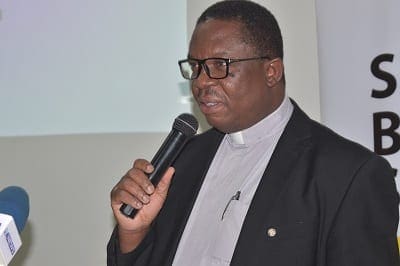
Reverend Dr. Cyril Fayose, General Secretary of the Christian Council of Ghana, has unequivocally rejected allegations of causing financial loss to the Evangelical Presbyterian Church, Ghana (EPCG). The accusations relate to a GHS 2 million loan secured for the EPCG University during his leadership as President. Dr. Fayose maintains the loan was a critical institutional decision to address severe infrastructure deficits and comply with regulatory demands.
These allegations suggest Dr. Fayose burdened the EPCG with debt through a university loan, which detractors claim he used to inflate management and staff salaries. This, they argue, disqualifies him from holding future church offices. Dr. Fayose, also Director of the National Counselling Centre, Adenta, believes these claims are a smear campaign linked to his interest in contesting for Moderator of the General Assembly of the Church in August.
This situation highlights broader governance challenges within Ghana's tertiary education sector and religious institutions. Universities often struggle with funding infrastructure development while adhering to strict accreditation standards. The incident also underscores the political dynamics within large organizations, where financial decisions can become contentious during leadership contests. Ghana's economic landscape, with its fluctuating student enrollment figures and increasing competition among tertiary institutions, further complicates financial planning for universities.
“These allegations have been made without affording me the opportunity to present my side of the story,” Rev Dr Fayose stated in a release from Ho. He emphasized that a fair assessment requires understanding the institutional challenges he inherited, the regulatory environment, and the governance structures that approved decisions. He noted that the University Council approved the loan, and the Church provided necessary guarantees, indicating a collective decision-making process.
The immediate implication is a potential disruption to the upcoming General Assembly of the Church in Ho. The allegations could influence the election for the Moderator position, impacting the EPCG's leadership stability. Decision-makers within the EPCG will need to conduct a thorough and transparent investigation to clarify the facts. The outcome will be closely watched by other religious and educational institutions facing similar financial and governance pressures.
Rev Dr Fayose assumed office as the second President of the University in October 2011, succeeding Mr. Walter Blege. He inherited a university already servicing a loan from GCB Bank for campus renovations. In 2012, the National Accreditation Board (NAB) formally warned the university about inadequate infrastructure. NAB made it clear that failure to improve facilities could lead to a loss of institutional accreditation.
The Board also stipulated that student fees could not finance the required infrastructure improvements. Faced with this regulatory pressure, the University and Church, under then-Moderator Rt Rev Francis Amenu, released land for a new lecture complex. They also made available lands at Akoefe, Ve Koloenu, and Todome. These were deliberate institutional decisions aimed at preserving the university's future, as Dr. Fayose inherited significant infrastructure deficits.
The university lacked adequate infrastructure for a growing tertiary institution when he became President. Its operational inefficiencies fell short of accredited university standards. These challenges existed long before his administration and posed a significant threat to the university's future. Against this background, a decision was made to secure a loan of approximately GHS 2 million to construct a modern lecture hall complex.
“This was not a project undertaken for prestige or personal recognition but a strategic intervention to address an immediate institutional crisis and satisfy accreditation requirements,” Rev Dr Fayose clarified. He added that Defiat Company, which constructed the complex, received payments based on work certificates. Only the final stages of work remained unpaid when the Church took over, refuting claims that the company pre-financed the entire project.
At the time the loan was contracted, the university possessed the financial capacity to service it. Student enrollment was healthy, cash flow projections were favorable, and the Church guaranteed the loan through a proposed GHS 1 per member per month contribution. Dr. Fayose stressed that none of the borrowed funds were used for staff salaries or recurrent expenditure. Every cedi was invested in capital infrastructure, which remains the property of the University and Church.
The university's repayment projections were later undermined by unforeseen external developments. Key among these was the conversion of Ho Polytechnic into a Technical University. Several public universities also established distance learning centers in Ho. These developments led to a sharp decline in enrollment and revenue, affecting the university's ability to service the loan as originally projected. Dr. Fayose concluded that in the absence of fraud, dishonesty, personal gain, recklessness, or misuse of funds, there is no fair basis for accusing him of financial loss.