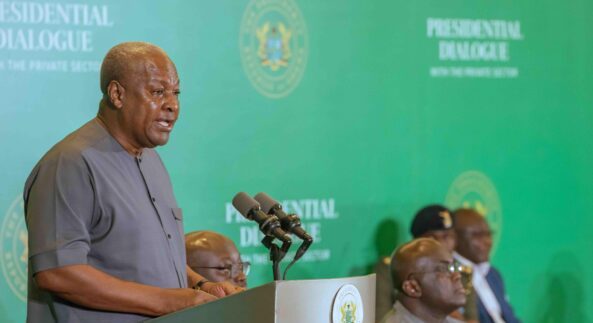
President John Dramani Mahama has signed 10 bills passed by Parliament into law. This legislative action includes critical reforms targeting taxation, national security, and judicial processes.
Among the assented bills are the Income Tax (Amendment) Bill, 2026, the Value Added Tax (Amendment) Bill, 2026, and the Energy Sector Levies (Amendment) Bill, 2026. These fiscal measures are designed to enhance government revenue collection and ensure the stability of Ghana's vital energy sector.
This legislative push fits into Ghana's broader economic strategy to strengthen public finances and improve regulatory frameworks. The government has consistently sought to broaden its tax base and plug revenue leakages to support national development. Previous efforts have focused on similar fiscal adjustments to meet budget targets and reduce reliance on external borrowing.
President Mahama expressed confidence that the new legislation would significantly contribute to Ghana's development agenda. He stated these laws would improve the lives of citizens by fostering economic growth and stability. The bills received parliamentary approval before the recent recess, and the President's assent brings them into full legal effect.
The implications of these new laws are far-reaching for businesses and citizens. The Income Tax (Amendment) Bill, 2026, introduces adjustments to personal income tax bands and corporate tax rates. This will directly affect individuals' disposable income and companies' profitability. The Value Added Tax (Amendment) Bill, 2026, aims to fine-tune the VAT system, enhancing compliance and broadening the tax base. Businesses must adapt to these revised tax structures, which could influence pricing and operational costs.
Furthermore, the Energy Sector Levies (Amendment) Bill, 2026, modifies existing levies on petroleum products. The government indicates these adjustments are necessary to sustain the energy sector's stability. Consumers could see changes in fuel prices, impacting transportation costs and overall inflation. The Customs Bill, 2026, replaces older legislation, introducing modern procedures for goods clearance and enhanced revenue mobilization at borders. This aims to improve trade facilitation while reducing illicit trade activities.
The Ghana Cocoa Board Bill, 2026, reorganizes COCOBOD's structure and operations. It introduces governance reforms and strengthens the Board's regulatory powers. This is expected to improve the cocoa sub-sector's contribution to the national economy. Cocoa farmers and stakeholders will experience changes in how the industry is managed and regulated. The Excise Bill, 2026, consolidates and modernizes excise duty legislation. It provides a comprehensive framework for collecting duties on goods like tobacco and alcohol, ensuring more efficient revenue collection from these products.
Beyond fiscal matters, other bills address judicial and security reforms. The Community Service Bill, 2026, offers an alternative sentencing option for non-violent offenders. This aims to reduce prison overcrowding and promote rehabilitation. The Tribunals Bill, 2026, restructures the country's tribunal system. It establishes specialized courts for commercial disputes, human rights, and election petitions, aiming to speed up justice administration. The Maritime and Related Offences Bill, 2026, criminalizes piracy and illegal fishing, strengthening Ghana's capacity to police its territorial waters. The National Defence University Bill, 2026, establishes a new tertiary institution for defence and security studies. These reforms collectively enhance Ghana's governance, security, and legal frameworks, creating a more stable environment for economic activity and citizen welfare.