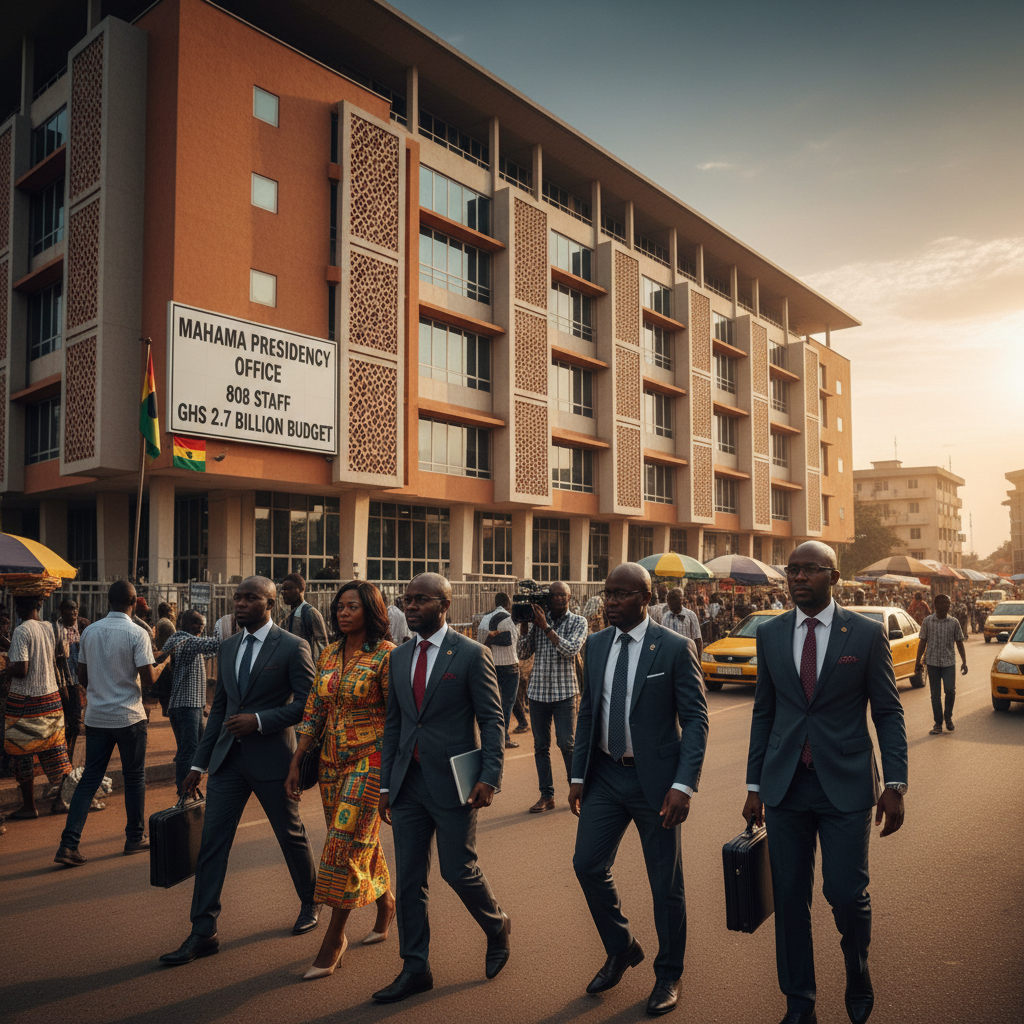
The Office of the President during the Mahama administration is reported to have employed 808 staff members. This figure combines 233 political appointees and 575 civil and public servants working under the presidency. The Office of Government Machinery (OGM), which includes the Presidency and related agencies, received a budget allocation of GHS 2.7 billion in the 2025 national budget.
This substantial budget allocation and large staff size have triggered public debate regarding government spending. Political appointees include senior advisors, executive assistants, and directors. Civil and public servants come from various state institutions like the Ghana Broadcasting Corporation and the Information Services Department. They remain on the national payroll through the Controller and Accountant-General’s Department.
This expenditure forms part of Ghana’s total projected national expenditure of GHS 290.9 billion for 2025. Personnel costs, covering salaries and allowances for both political appointees and civil servants, represent a major part of the Presidency’s allocation. Ghana is currently facing economic challenges, including pressure to reduce overall expenditure and manage debt obligations. The cost of running the Presidency adds to concerns about the public purse.
Official sources explain that the GHS 2.7 billion budget does not solely cover the President's personal expenses. Instead, it consolidates the costs of multiple institutions operating under the Office of Government Machinery. These institutions provide essential support for governance, public communication, auditing, and national coordination. They underpin the functioning of the state bureaucracy.
However, the significant combined workforce of over 800 people and the multi-billion-cedi allocation have drawn criticism. Critics argue that this heavy financial burden is problematic. This is particularly true when the government struggles to pay cocoa farmers and faces broader economic constraints. The scale of presidential expenditure frequently becomes a point of contention in Ghanaian political discourse.
The current debate highlights ongoing concerns about fiscal responsibility and government efficiency. Lawmakers and public finance experts will continue to scrutinize such allocations. Future budget approvals for the Office of Government Machinery will likely face closer examination. This situation may influence public perceptions of fiscal management and lead to demands for greater transparency in government spending.
Understanding the structure and cost of the Presidency is crucial for assessing Ghana's public financial health. This ongoing discussion will shape expectations for government accountability. It can also impact future policy decisions aimed at controlling public sector costs. Decision-makers must balance the need for effective governance with prudent financial management.