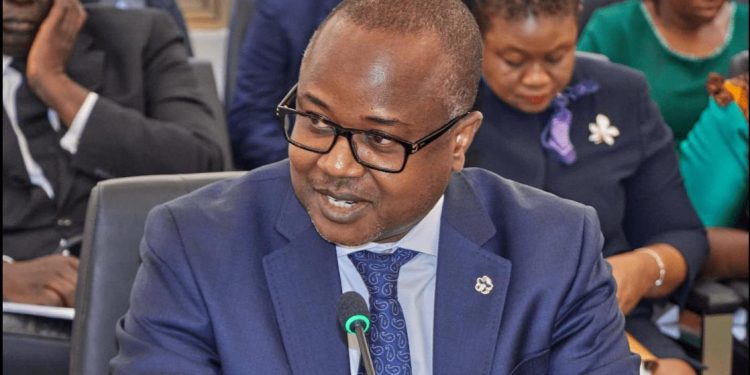
Ghana's 2022 debt distress was preceded by warning signs not fully reflected in international assessments. Dr. Maxwell Opoku-Afari, former First Deputy Governor of the Bank of Ghana, argues this in a new policy paper. His study, published by the Finance for Development Lab, questions the adequacy of debt sustainability frameworks applied to Ghana.
The paper highlights that successive IMF-World Bank Debt Sustainability Analyses (DSAs) identified growing vulnerabilities. Ghana was classified at high risk of debt distress as early as 2015. However, these assessments continued to regard the debt as sustainable. This was based on assumptions like continued market access and successful fiscal consolidation. Dr. Opoku-Afari contends the issue was not a lack of warnings. Instead, it was how these signals translated into crisis probability and speed assessments.
This situation fits into Ghana's broader economic narrative of recurring fiscal challenges. The present value of public debt-to-GDP sharply increased after 2014. It reached nearly 93 percent by 2022, up from below 55 percent in the early 2010s. Debt-service pressures were even more pronounced. The external debt service-to-revenue ratio breached its benchmark by 2013. It exceeded 40 percent of government revenue by 2022. Interest payments consistently stayed above 20 percent of government revenue. International reserves hovered near the conventional minimum of three months of import cover. These indicators pointed to growing liquidity problems alongside overall debt deterioration.
Dr. Opoku-Afari's paper specifically criticizes the Low-Income Country Debt Sustainability Framework (LIC-DSF). He states the framework was not responsive enough to Ghana's evolution into a frontier economy. Ghana had significant access to international capital markets and a sophisticated domestic debt market. Crucially, the framework did not sufficiently capture risks from domestic debt. This became vital as the government shifted towards domestic borrowing. Commercial banks, pension funds, insurance companies, and foreign investors became major holders of government securities. The paper argues this strategy changed the form of risk, rather than eliminating it.
The weighted-average interest rate on Ghana’s public debt was estimated at 10.7 percent. A significant 17.5 percent of the debt stock was due to mature within one year. Foreign-currency-denominated debt averaged 54.5 percent of total public debt. This left Ghana heavily exposed to exchange-rate movements. This created a dangerous interaction between debt quantity and quality. As interest payments rose, the government needed to borrow more. Refinancing occurred at increasingly expensive rates. The depreciation of the Ghana cedi simultaneously increased the domestic-currency value of external obligations.
Dr. Opoku-Afari identifies three key shortcomings in the surveillance architecture. First, baseline projections were often overly optimistic. They relied heavily on assumptions of sustained fiscal consolidation and robust economic growth. Second, domestic-debt dynamics and their feedback loop with the financial sector were not fully understood. Third, successive adjustment programmes focused more on near-term fiscal consolidation. They neglected structural weaknesses that repeatedly caused fiscal pressures. These weaknesses included energy-sector inefficiencies and state-owned enterprise governance issues. The paper concludes that Ghana could restore macroeconomic stability periodically. However, it failed to eliminate the underlying causes of repeated debt accumulation.
Ghana's repeated return to the IMF, with 17 programmes in six decades, highlights a deeper policy concern. Dr. Opoku-Afari suggests that stabilisation has not consistently led to durable structural adjustment. Fiscal consolidation can improve headline indicators, but gains remain vulnerable if underlying fiscal risks are unresolved. The lesson from Ghana extends beyond its borders. As African economies develop domestic capital markets, traditional assessments focusing on external debt may be insufficient. Dr. Opoku-Afari calls for greater attention to liquidity and refinancing risks. He also stresses the importance of domestic debt costs, sovereign-bank linkages, and stress-testing public finances.