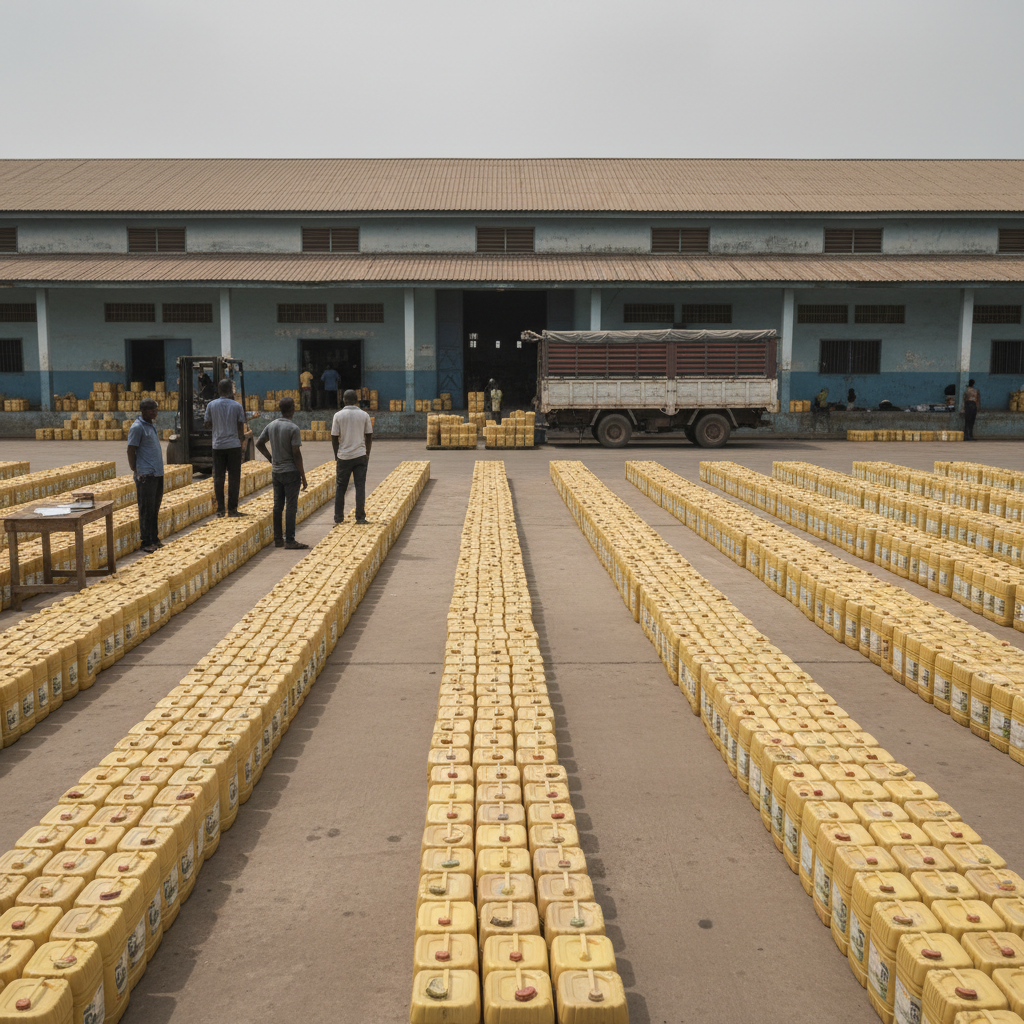
The Ghana Revenue Authority (GRA) has donated 39,256 jerry cans of vegetable cooking oil, confiscated earlier this year, to the National School Feeding Programme. This action follows investigations that uncovered widespread customs fraud linked to the consignment. The GRA also interdicted four Customs officers involved in processing the goods.
The donation came after concluding investigations into the interception of 18 trucks. These trucks were initially declared as transit cargo moving from Togo through Ghana to Niger. The probe revealed falsified trade documentation, under-declaration of goods, and incorrect tariff classification. It also exposed other irregularities in the declaration process.
This incident highlights a major challenge in Ghana's revenue collection efforts and border security. Customs fraud, like under-declaration and misclassification, directly reduces government revenue. Such activities undermine fair trade practices and can distort local markets. The interception of transit goods, destined for re-export but diverted to the local market, represents a significant breach of customs regulations. Ghana aims to improve its revenue collection to GHS 176.4 billion in 2024, a 28.1% increase from 2023. Cases like this demonstrate the obstacles the GRA faces in achieving these targets.
Mr. Anthony Kwasi Sarpong, the Commissioner-General of the GRA, addressed a media briefing in Accra. He stated that the decision to allocate the confiscated goods to the School Feeding Programme was a directive from the Ministry of Finance. He explained that a joint team of Customs officers and National Security personnel intercepted the trucks in February at the Gorm barrier on the Tema Motorway. This followed intelligence that the cargo, declared as transit goods, was being diverted onto the local market.
The GRA's actions send a strong signal about its commitment to combating illicit trade and protecting national revenue. The interdiction of Customs officers suggests an internal cleanup effort. Future developments will likely involve the outcome of disciplinary proceedings against the officers and any legal actions against the clearing agent. These enforcement measures are critical for deterring similar fraudulent activities. They aim to safeguard Ghana's economic stability and ensure compliance with trade laws.
Investigations established that export documents from Togolese Customs showed the goods originated from Malaysia and Indonesia. They were destined for two companies in Abidjan, Côte d’Ivoire. This contradicted declarations made at Ghana’s Akanu border that stated Niger as the final destination. The declarations processed at the border lacked supporting bills of lading or export documents. They relied instead on invoices claiming the goods were purchased from the open market in Togo.
Further investigations revealed significant discrepancies. Customs records declared 35,246 jerry cans of vegetable cooking oil. However, a physical examination uncovered 39,256 jerry cans, showing an under-declaration of 4,010 jerry cans. A consignment declared as tomato paste was found to contain tomato seasoning powder. The cooking oil was also wrongly classified under a tariff attracting a 20% import duty. The applicable rate was 35%, resulting in a substantial understatement of the required bond guarantee.
The GRA also conducted inquiries with the Nigerian Chamber of Commerce. These inquiries failed to verify the taxpayer identification details of the named consignee, Adamu Mumuni. This raised concerns about the consignee's authenticity. A review of the Integrated Customs Management System (ICUMS) uncovered 44 previous transit declarations linked to the same consignee. Several of these entries lacked supporting bills of lading and exhibited similar irregular exit patterns at the Kulungugu border.
Mr. Sarpong assured the public that the Customs Division has intensified compliance measures at the country’s borders. This is to safeguard revenue and curb illicit trade. The Authority will continue to enforce the law against persons engaged in customs-related offenses.