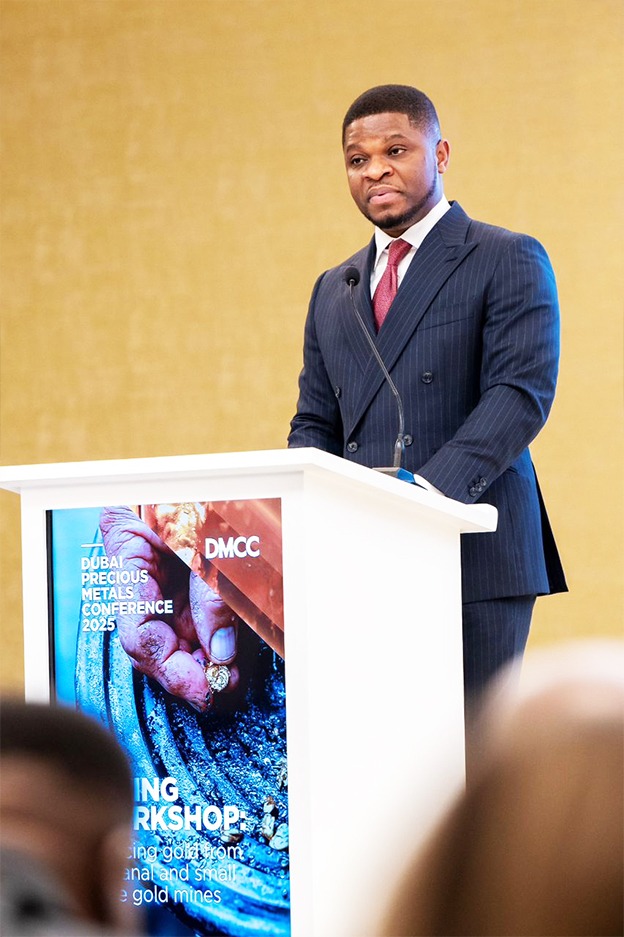
Ghana's GoldBod achieved an overall surplus of GHS 5.4 billion in 2025, according to its Chief Executive Officer, Sammy Gyamfi. This announcement directly challenges assertions that the national gold board recorded losses during the period.
Mr. Gyamfi also dismissed claims by Minority Leader Alexander Afenyo Markin. Markin had suggested GoldBod was responsible for losses incurred by the Bank of Ghana (BoG) under its Domestic Gold Purchase Programme (DGPP). Gyamfi stated that GoldBod's audited annual report for 2025, published by the Auditor-General, shows an operational surplus of GHS 907 million. This financial performance underscores the company's profitability.
This financial clarification comes amidst broader scrutiny of Ghana's public finances and the performance of state-owned enterprises. The country is currently navigating an International Monetary Fund (IMF) programme. The IMF's sixth review report highlighted a US$1.7 billion loss by the Bank of Ghana under the DGPP in 2025. Such financial disclosures are critical for maintaining investor confidence and ensuring fiscal discipline. The government's ability to manage state assets effectively is a key component of its economic recovery strategy.
Speaking at the Government Accountability Series, Mr. Gyamfi described the loss claims as a "barefaced lie." He challenged Mr. Markin to identify any part of the IMF report that attributes BoG's DGPP losses to GoldBod. Gyamfi clarified GoldBod's role was solely as a gold buying agent for the BoG. This role was a continuation of the defunct PMMC's function under a 2023 agreement. GoldBod was not involved in selling gold, determining prices, or signing off-take agreements under the DGPP.
The implications of these statements are significant for public perception and accountability. GoldBod's clear financial position could alleviate concerns about its operational efficiency. However, the Bank of Ghana's reported losses under the DGPP remain a critical issue. Decision-makers will need to scrutinize the policy design of the DGPP. Markets will watch for further clarity on how these losses impact the central bank's balance sheet and Ghana's overall economic stability. The government must ensure transparency in all state-backed financial activities.
Mr. Gyamfi further explained that GoldBod fully accounted for approximately GHS 133 billion advanced to it in 2025. He pointed out that the IMF reports cited a US$400 million loss from gold sales under the DGPP in 2024. GoldBod did not exist in 2024, raising questions about the cause of those earlier losses. This historical context is vital for understanding the programme's financial trajectory.
GoldBod received an assay fee of 0.258% and a service fee of 0.5%, totaling 0.758%. These fees are standard and cover operational costs like transportation, logistics, and insurance. Mr. Gyamfi emphasized these fees represent less than 1% of the 17% loss value reported by the IMF. This small percentage suggests GoldBod's fees are not a primary driver of the BoG's DGPP losses.
He also corrected the notion that the Bank of Ghana pulled out of financing GoldBod. Gyamfi stated that the BoG never financed GoldBod directly. Instead, the BoG advanced funds to GoldBod to facilitate its own gold purchases. This distinction clarifies the financial relationship between the two entities. Funds were for the BoG's programme, not GoldBod's institutional financing.
From March to June 2026, the BoG paid baseline GANRAP Implementation Costs. Responsibility then shifted to the Ministry of Finance in July 2026. Effective August 2026, GoldBod indicated its intention to raise funds for its artisanal and small-scale mining (ASM) purchases independently. This move aims to reduce reliance on the BoG as an intermediary. GoldBod's defense of its 2025 performance is not an attempt to shift blame for DGPP losses. Instead, it highlights that these losses stem from policy design, not mismanagement by GoldBod.