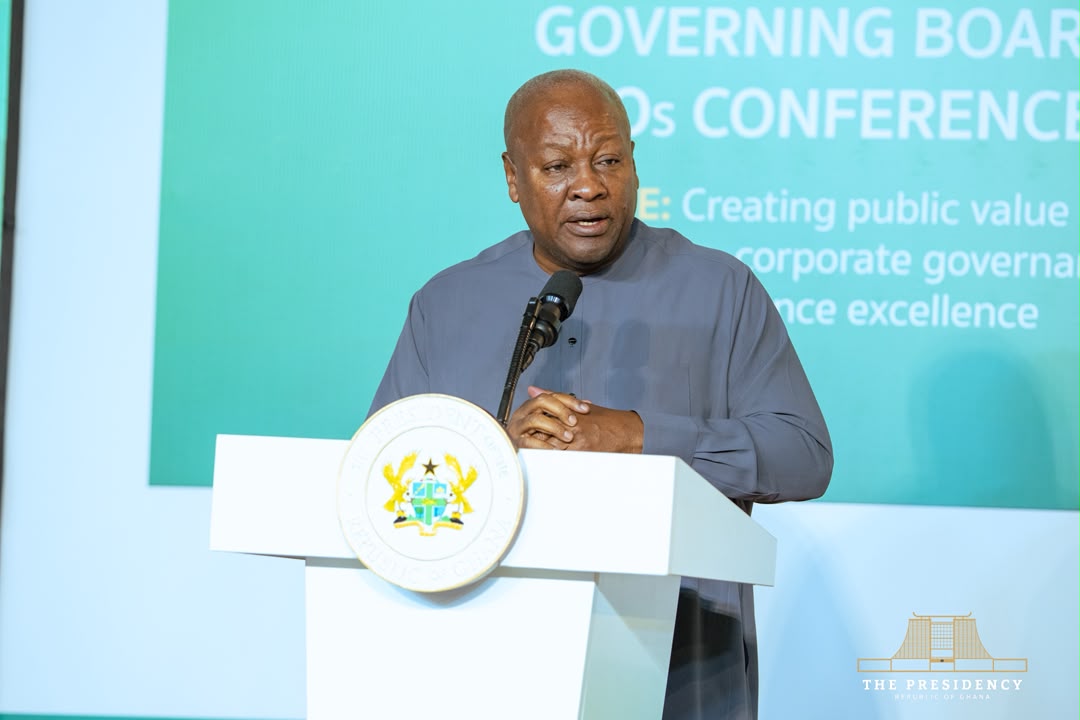
Ghana's state-owned enterprises (SOEs) collectively achieved a significant financial turnaround, moving from an aggregate net loss of GHS 2.26 billion in 2024 to a net profit of GHS 19.8 billion in 2025. President John Dramani Mahama has challenged SOE boards and chief executives to demonstrate measurable value from public resources entrusted to them. He emphasized that these institutions must create public value and be financially sustainable.
This impressive shift in profitability was highlighted in the latest State Ownership Report. The report also showed that the combined revenue of state-owned enterprises increased from GHS 137.71 billion in 2024 to GHS 176.43 billion in 2025. Return on assets improved from 1.3 percent to 6.31 percent, while return on equity rose from a negative 1.6 percent to 15.7 percent. President Mahama, however, cautioned that a stronger business environment, including GHS 11.72 billion in foreign exchange gains and a 42.5 percent reduction in finance costs, significantly contributed to this improvement. He urged SOEs to convert this financial relief into sustained operational efficiency and stronger underlying performance.
This financial recovery for SOEs is crucial for Ghana's broader economic stability and public finance management. Historically, many state enterprises have been a drain on the national budget, requiring government bailouts and subsidies. The improved performance suggests a potential reduction in fiscal risks and a greater capacity for the government to invest in critical social infrastructure. This trend aligns with ongoing efforts to enhance public sector efficiency and reduce the overall public debt burden. The President's call for accountability underscores a commitment to fiscal discipline and prudent management of state assets, which are vital for investor confidence and long-term economic growth.
President Mahama stressed that leadership positions within state enterprises must be tied to measurable performance, value creation, and profitability. He reminded heads of state institutions that they hold public assets in trust and must account for their stewardship. He stated, “Performance contracts are not administrative paperwork; they are covenants with the people of Ghana.” This statement reinforces the government's expectation for tangible results and responsible management from all state-owned entities.
The implications of this directive are far-reaching for Ghana's economic landscape. SOE leaders will face increased pressure to deliver consistent profits, create jobs, and contribute to national development. Persistent underperformance will trigger corrective action, including potential leadership changes. This focus on performance will likely lead to greater transparency and efficiency within the state sector, potentially attracting more private sector investment and partnerships. Investors and citizens will closely watch how these enterprises sustain their profitability and contribute to Ghana's overall economic resilience, especially as the government seeks to reduce its reliance on external financing and strengthen domestic revenue generation.
Several state institutions recorded significant recoveries during 2025. Tema Oil Refinery (TOR) moved from a loss of GHS 745 million to a profit of GHS 1.09 billion, its strongest performance in almost a decade. Ghana Water Limited also shifted from a loss of GHS 3.06 billion to a profit of GHS 635 million. The Ghana Cocoa Board recovered from a loss of GHS 5.73 billion to a profit of GHS 5.11 billion. BOST increased its net profit from approximately GHS 3.98 million to GHS 6.84 million. GoldBod also recorded a sharp improvement, with net profit rising from GHS 178.5 million to GHS 896.5 million. These turnarounds demonstrate the value of strategic reforms and improved management practices.
President Mahama commended ten state-owned enterprises that remained profitable every year between 2021 and 2025. The Ghana National Petroleum Corporation recorded the highest average annual profit of approximately GHS 2.25 billion. The Ghana Ports and Harbours Authority followed with GHS 1.41 billion. The Minerals Income Investment Fund recorded average profits of GHS 773.9 million. Bui Power emerged as a new dividend-paying institution with average profits of GHS 348.1 million. Other consistent performers included the Volta River Authority, Ghana Exim Bank, Ghana National Gas Corporation, TDC Company Limited, Ghana Supply Company Limited, and the Venture Capital Trust Fund. The President noted that consistency in performance creates an obligation for such institutions to pursue even higher standards of governance and efficiency.
Despite these successes, President Mahama expressed concern over continued weaknesses within parts of the state enterprise portfolio. Five state-owned enterprises recorded losses in every year between 2021 and 2025. Other state entities recorded an aggregate deficit of GHS 10.48 billion in 2025. The liabilities of these institutions continue to exceed their net assets, requiring urgent corrective action. President Mahama warned commercial state-owned enterprises against treating the national budget as a permanent financial cushion. He directed boards to improve revenue, reduce costs, manage debt, and eliminate structural inefficiencies before they become fiscal risks. Profitable enterprises, he added, must honour their dividend obligations because public returns belong to the Ghanaian people.