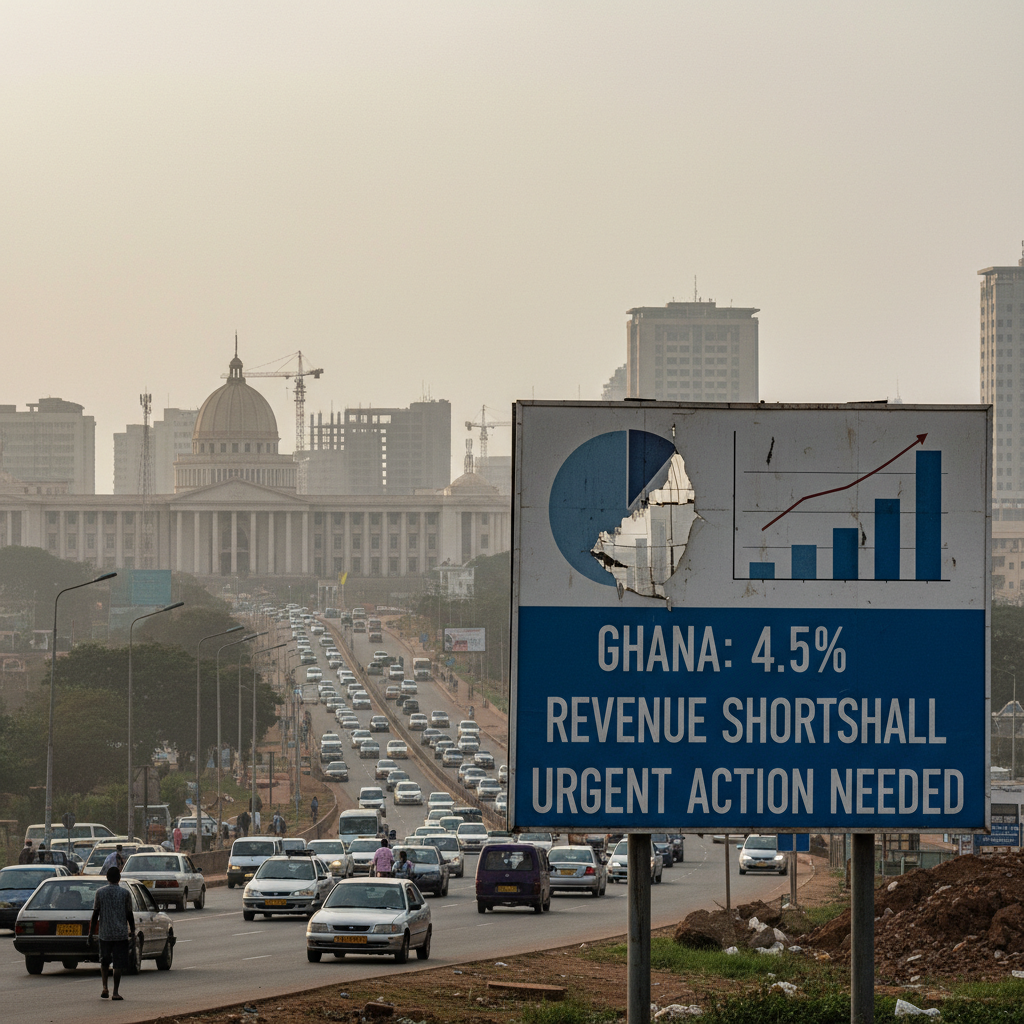
Ghana recorded a 4.5% shortfall in total revenue and a 5.0% decline in tax revenue during the first quarter of 2026. This significant underperformance in revenue collection has prompted calls for immediate policy adjustments in the upcoming Mid-Year Budget Review.
Professor Peter Quartey, former Director of the Institute of Statistical, Social and Economic Research (ISSER), urged Finance Minister Dr. Cassiel Ato Forson to outline concrete measures to improve domestic revenue mobilization. He highlighted that weaker-than-expected tax collections threaten the nation's ability to sustain economic growth and fund essential government programs. The shortfall indicates a critical need to bolster the government's income streams.
This revenue challenge emerges despite encouraging signs of macroeconomic stability in Ghana. Recent improvements in inflation, exchange rate stability, and fiscal performance have created a foundation for economic management. However, Professor Quartey stressed that this stability alone is insufficient to tackle broader economic issues, particularly high unemployment. The country needs to move beyond stabilization to active growth and job creation.
Professor Quartey stated, "Our economy remains relatively stable in terms of its fiscal performance. We've seen inflation at a reasonable level. We've seen depreciation at a very reasonable level and fiscal deficits also at a reasonable level." He cautioned that while stability is good, it must be a launchpad for further economic progress. He likened it to an aircraft needing to take off after taxiing on the runway, emphasizing the need to address "jobless growth" where economic expansion does not create enough employment opportunities.
The implications of this revenue shortfall are significant for Ghana's economic outlook. Continued reliance on expenditure cuts, while aiding fiscal consolidation, could severely impact the operations of ministries, departments, and agencies. Professor Quartey warned that reduced government spending is already affecting service delivery in critical sectors. The Finance Minister's 2026 Mid-Year Budget Review, expected today, will be closely watched for strategies to boost revenue without stifling economic activity or public services. Decision-makers and markets will scrutinize the proposed measures to ensure sustainable growth and job creation.
The Ministry of Finance's data for the first quarter of 2026 showed prudent expenditure management, with spending at 3.5% of GDP against a target of 4.9%. This indicates the government spent less than budgeted. However, the simultaneous dip in revenue numbers underscores a fundamental imbalance. The government's ability to finance its development agenda and provide public services hinges on its capacity to generate sufficient domestic revenue. Without this, the current stability could prove fragile, hindering long-term economic prosperity and social development.