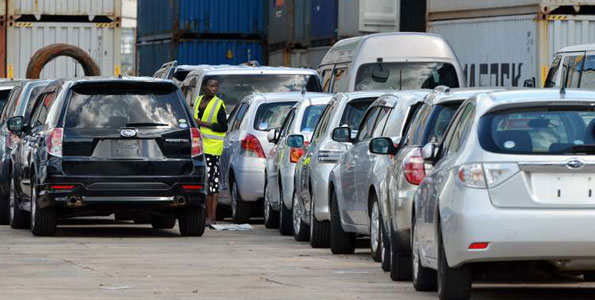
Ghana's Customs Division of the Ghana Revenue Authority (GRA) has clarified that varying import duty rates for seemingly similar vehicles are not arbitrary. These differences stem from the vehicle's classification, which considers specific technical details. This explanation aims to bring transparency to the import duty assessment process for vehicles entering Ghana.
The Customs Division bases its assessment on a vehicle's precise specifications, including engine capacity, fuel type, and year of manufacture. This information, derived from the Vehicle Identification Number (VIN), determines the appropriate tariff classification. This method ensures that duty calculations are consistent and fair across all imports, addressing common misconceptions among vehicle importers.
This clarification comes amidst ongoing discussions about Ghana's import policies and their impact on the economy. Vehicle imports represent a significant portion of Ghana's trade, affecting both government revenue and consumer costs. Understanding these duty structures is crucial for businesses and individuals planning to import vehicles into the country, influencing market prices and demand.
Daniel Kwame Ntem, a senior revenue officer at the Customs Technical Services Bureau's Vehicle Valuation Unit, explained the process during a radio discussion on Joy FM. He stated, "We don't just look at the vehicle and say this vehicle is nice, so the rate should be 20 per cent. It is through the classification that we are able to arrive at the rate." This highlights the structured approach Customs employs.
The GRA's detailed explanation implies a continued focus on revenue generation through customs duties, a critical component of Ghana's public finance. Importers should anticipate that the technical specifications of their vehicles will be the primary determinant of duty. This approach aims to reduce disputes and provide greater predictability in import costs.
The classification process begins with identifying the vehicle's exact specifications using its VIN, also known as the chassis number. Customs officers use this number to determine the vehicle's engine capacity, fuel type, year of manufacture, seating capacity, and body type. These details are then used to place the vehicle under the appropriate tariff classification, which dictates the applicable import duty rate.
Two vehicles that appear identical can attract different duty rates due to subtle differences in their technical specifications. For instance, a Toyota RAV4 with a 2.4-litre petrol engine might fall into a 10% duty band. A Toyota Highlander with a 3.5-litre petrol engine, despite being a similar make, could attract a 20% duty due to its larger engine capacity. This principle applies broadly across various vehicle types and models.
Ghana's Customs tariff schedule categorizes imported vehicles into three primary duty bands. Buses, trucks, articulated vehicles, and some passenger vehicles with smaller engine capacities generally attract a 5% import duty. Many mid-sized petrol and diesel passenger vehicles, including popular family saloons and SUVs, fall within the 10% band. Larger-engine passenger vehicles, including most petrol vehicles above 3,000cc and diesel vehicles above 2,500cc, typically attract a 20% duty. This 20% band also includes standard hybrid and electric passenger vehicles under the current tariff.
Customs does not simply use the purchase price because identical vehicles can sell at different prices due to negotiations, discounts, or auction conditions. Relying on purchase price would lead to inconsistent and unfair assessments. Instead, Customs starts with the Manufacturer's Suggested Retail Price (MSRP), also known as the Home Delivery Value (HDV), and applies approved depreciation based on the vehicle's age. This method ensures a standardized and equitable valuation process for all imported vehicles.
This detailed framework for import duty calculation provides clarity for stakeholders in Ghana's automotive sector. It underscores the importance of understanding vehicle specifications before importation to accurately estimate costs. The GRA's commitment to transparency in this area supports a more predictable and fair trading environment.