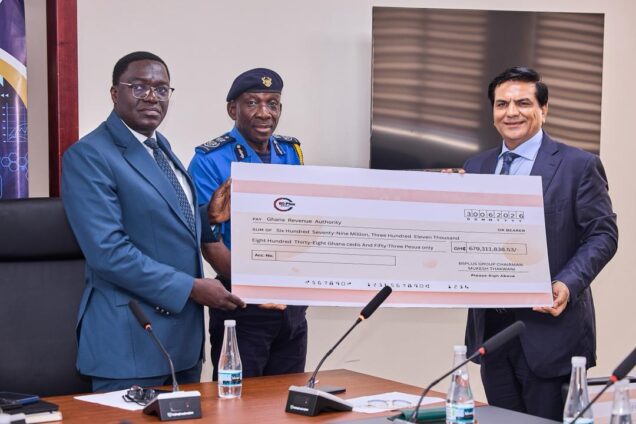
B5 Plus Company Limited has presented a GHS 400 million tax cheque to the Ghana Revenue Authority (GRA). This substantial payment significantly boosts domestic revenue mobilisation efforts. It also highlights the growing connection between industrial expansion and fiscal sustainability in Ghana.
This payment comes as the government aims to strengthen revenue collection. Ghana seeks to reduce its dependence on borrowing. The goal is to create more fiscal space for essential infrastructure and public services. Its importance extends beyond simply adding funds to government coffers.
Ghana faces repeated expenditure pressures that often exceed domestic revenue. A larger, productive tax base offers a more stable path to fiscal consolidation. This approach is more durable than constant reliance on debt. The nation’s revenue strategy is therefore deeply connected to its industrial strategy.
Dr. Martin Kolbil Yamborigya, Commissioner of the GRA’s Domestic Tax Revenue Division, praised B5 Plus for its compliance. He directly linked taxation to national development. Dr. Yamborigya stated that taxes paid by businesses help finance crucial public services. These include roads, schools, hospitals, security, and social interventions.
This argument captures a key tension in Ghana’s fiscal policy. The government needs stronger revenue. However, taxpayers increasingly expect clear evidence that their contributions are used for productive public spending. This distinction between tax revenue and borrowing is especially important for the nation's long-term health.
Borrowed money creates future obligations through principal and interest payments. Tax generated from expanding production does not carry the same debt-service burden. When higher tax receipts come from companies producing more, selling more, and employing more people, the fiscal gain is accompanied by broader economic benefits. This creates a virtuous cycle of growth and revenue.
Creating more large and profitable taxpayers requires several key conditions. These include reliable power, efficient ports and roads, and access to finance. Predictable regulation and protection against unfair competition are also vital. Tax administration can improve compliance, but it cannot create the productive capacity alone.
The government’s recent support for the steel industry illustrates this approach. In February, President John Dramani Mahama commissioned new facilities at B5 Plus’s Lakpleku operations. These included the Steel Ball, Section Mill, and PEP Extension Manufacturing Plants. These investments aim to boost local production and value addition.
President Mahama has also advocated restricting exports of non-ferrous scrap. This policy could increase access to raw materials for domestic processors. It would encourage the export of finished and semi-finished products instead of raw materials. He estimated this policy could lift processed-metal exports by US$250 million to US$300 million annually. It could also create between 5,000 and 10,000 jobs.
More domestic processing could generate various government revenues. These include corporate income tax, VAT, and PAYE (Pay As You Earn). It could also potentially reduce Ghana's dependence on imported finished products. The fiscal case for industrialisation extends beyond factory output. It encompasses the wider tax and foreign-exchange benefits when more value remains within Ghana.
Industrial policy must also ensure competitive operating conditions for manufacturers. This allows them to invest, expand employment, and compete with imports. Energy costs are particularly important for steel producers. President Mahama has linked continuous factory operations to the 24-hour economy programme. He argues that multiple shifts can raise productivity, reduce wastage, and increase exports.
The government has allocated GHS 110 million in the 2026 budget for the 24-hour economy programme. For manufacturers, the policy's credibility depends on delivering reliable electricity, efficient logistics, and a stable regulatory environment. Without these conditions, firms may struggle to expand enough to generate the larger tax base the government desires.
Tax administration forms the other half of the equation. Ghana’s 2026 VAT reforms abolished the COVID-19 Health Recovery Levy. They also introduced changes to simplify administration. The GRA continues expanding digital services through its Taxpayers’ Portal. These efforts aim to make tax compliance easier and more efficient for businesses across the country.