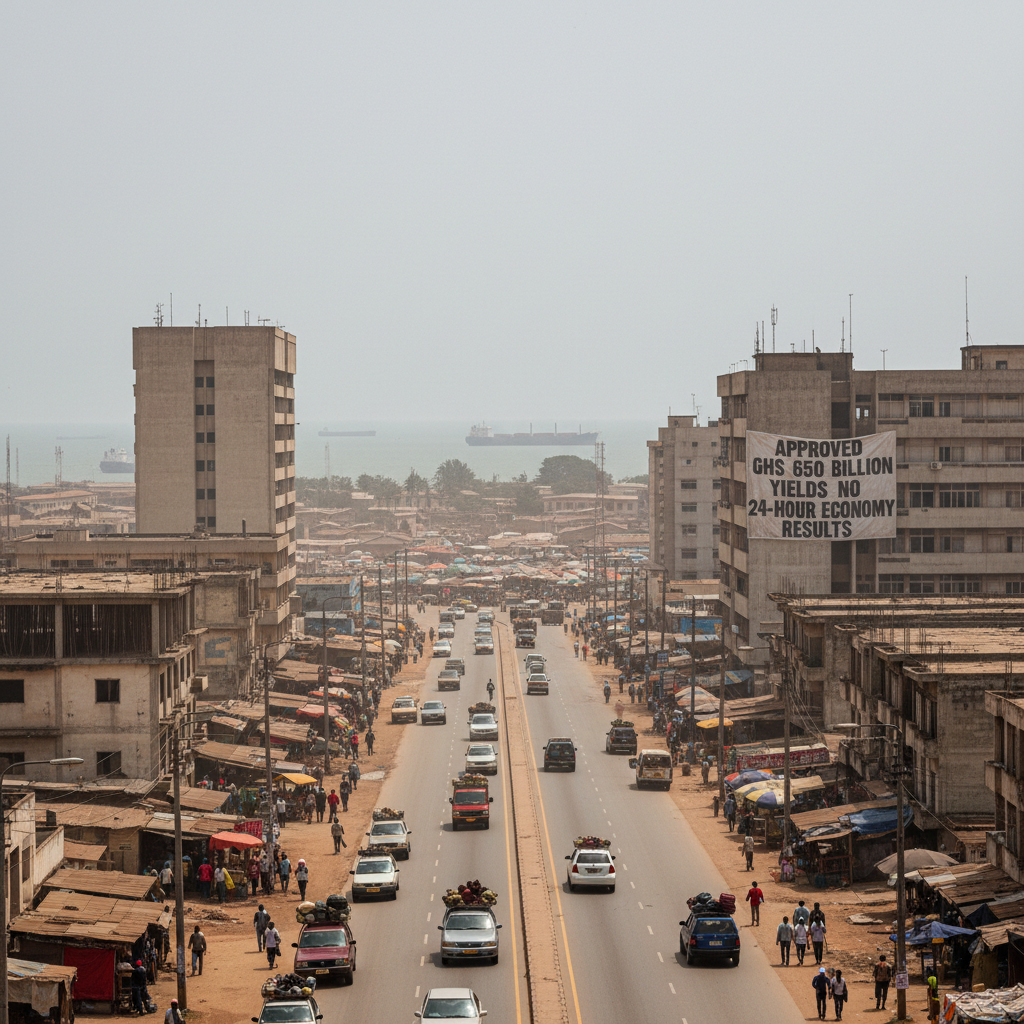
New Patriotic Party (NPP) lawmaker Kojo Oppong Nkrumah stated that the government's 24-Hour Economy programme shows no visible results, despite Parliament approving GHS 650 billion in public spending. He questioned the policy's implementation, arguing that almost two years after the National Democratic Congress (NDC) took office, there is little evidence of its operation. This significant expenditure has not translated into the promised economic expansion and job creation.
Mr. Nkrumah, speaking in Parliament, said the government has failed to demonstrate the programme's delivery. He noted the 24-Hour Economy was presented as an industrialisation and job creation strategy. Its core model involved 'one job, three people, three shifts' to boost production and employment. The lawmaker criticised the lack of government agencies implementing this specific model. He observed this while seconding a motion for the adoption of the Economy and Development Committee’s report.
This situation fits into a broader narrative of policy implementation challenges in Ghana. Previous administrations have also faced scrutiny over the delivery of flagship programmes. The effectiveness of public spending, especially large appropriations like GHS 650 billion, is frequently debated. Such fiscal commitments are meant to drive economic growth and job creation, vital for Ghana's developing economy. High youth unemployment, recorded at 32.4% by the Ghana Statistical Service, underscores the urgency of effective industrial policies.
Kojo Oppong Nkrumah, a Ranking Member on the Economy and Development Committee, specifically highlighted the problem. He told Parliament that close to GHS 650 billion was appropriated for government programmes. Yet, he added, the administration has not identified a single institution operating under the stated 'one job, three people, three shifts' model. He further criticised the government for shifting its focus. Parliament was told the government is now primarily building 24-hour markets and creating incentive packages for private businesses. This deviates from the original framework designed for widespread industrial expansion.
This lack of tangible progress could undermine investor confidence. Businesses need clear incentives before committing to additional production shifts and expanding their workforce. The delay in developing adequate fiscal and regulatory incentives could deter new investments. Lawmakers and markets will closely watch how the government addresses these criticisms. A swift and clear strategy for the 24-Hour Economy's implementation is crucial. It must demonstrate its ability to create sustained employment and drive economic transformation. The government's response will shape perceptions of its economic management capabilities.
Mr. Nkrumah suggested that constructing new markets alone may not guarantee continuous commercial activity. He pointed out that many existing markets operate only on specific days, despite having sufficient infrastructure. He urged the government to revive and strengthen the previous administration's One District, One Factory (1D1F) initiative. This programme, he stated, had already produced measurable results, with at least 150 projects operational by the end of 2024. He stated that economic transformation requires increased production and sustainable employment, not just policy announcements.