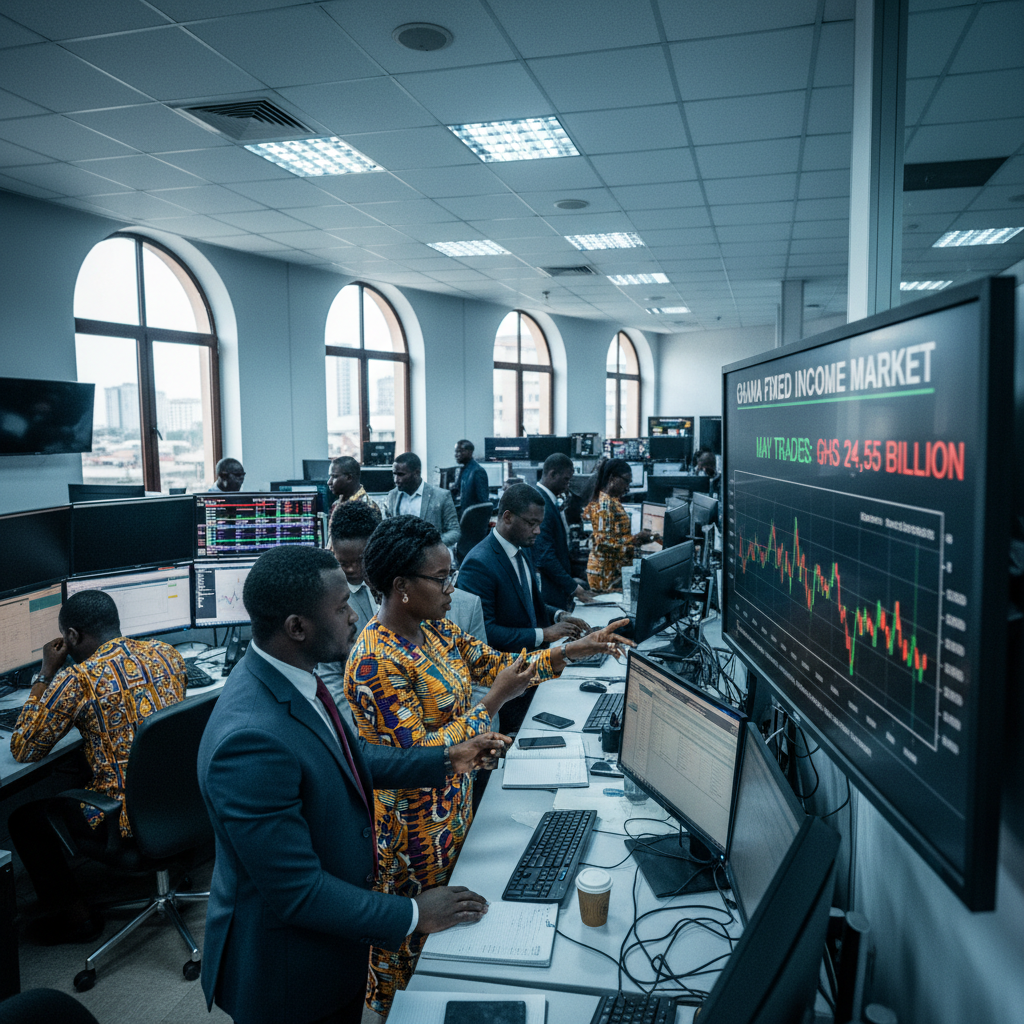
Ghana's Fixed Income Market (GFIM) recorded total trades amounting to GHS 24.55 billion in May 2026. This represents a substantial 55.86% increase in value compared to May 2025.
This significant rise occurred despite a sharp decline in the number of transactions. The total volume traded reached 26.58 billion, up from 17.99 billion in May 2025. The number of trades, however, fell by over 41% to 20,072 from 34,424 in May 2025. This trend suggests larger average transaction sizes, pointing to increased institutional participation and block trading in specific government securities.
The growth in fixed income trading aligns with broader improvements in Ghana's economic outlook. Declining yields on government securities reflect improving macroeconomic conditions and lower inflation expectations. This provides relief for the government's borrowing costs in the domestic market. The strong activity in longer-dated bonds also suggests investors are adjusting their positions along the yield curve as returns moderate from previous high levels.
According to the Ghana Stock Exchange’s Fixed Income Market Report for May 2026, government securities continued to dominate market activity. They accounted for GHS 24.41 billion in value traded. Corporate securities contributed a relatively modest GHS 136.16 million.
The improved market sentiment and declining yields will likely continue to influence investor behavior. Decision-makers in the Ministry of Finance will monitor these trends for future debt management strategies. The continued dominance of government instruments will remain a key feature of the GFIM. Investors, meanwhile, will adjust their portfolio strategies in response to moderating reinvestment returns.
Treasury bills were a major component of market activity. The 364-day bill recorded the highest value, with GHS 8.57 billion traded across 3,122 transactions. The 91-day bill followed with GHS 2.26 billion. The 182-day bill recorded GHS 1.73 billion in value traded.
Medium and longer-dated government bonds also saw strong investor activity. The 9-year Government of Ghana bond traded GHS 3.88 billion, making it one of the most active. The 4-year bond recorded GHS 2.78 billion. The 6-year bond saw GHS 960.62 million in trades. The 5-year bond traded GHS 740.05 million.
Yields across all maturities experienced a significant decline compared to May 2025. The 91-day bill yield fell to 6.69% from 14.17%. The 182-day bill dropped to 6.36% from 15.07%. The 364-day bill declined to 7.64% from 16.48%. On the bond market, the 4-year yield decreased to 10.50% from 20.92%. The 5-year yield declined to 9.80% from 21.28%. The 10-year bond yield dropped to 12.49% from 21.26%.
Cumulative market activity for the first five months of 2026 also remained robust. From January to May 2026, total value traded on the GFIM reached GHS 160.70 billion. This compares to GHS 79.61 billion in the corresponding period of 2025. This represents a 101.86% year-on-year increase in value traded for the period. Government securities accounted for GHS 157.77 billion of this cumulative trading activity.
Local US dollar bond activity also increased sharply in May. Local US dollar-denominated trades reached US$10.15 million. This is a significant rise from US$569,745 in May 2025. This increase suggests growing investor interest in foreign-currency fixed income instruments. These instruments likely reflect hedging demand and portfolio diversification strategies.