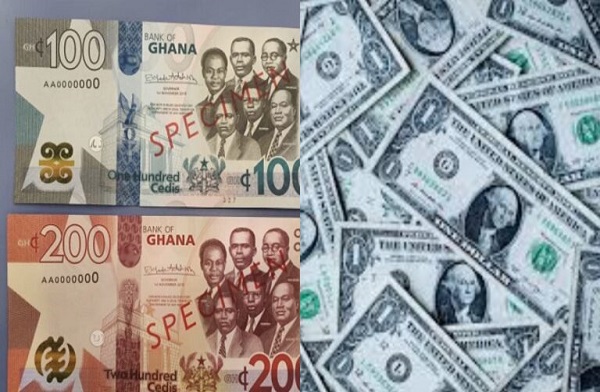
Ghana’s cedi depreciated by 9.50% against the US dollar in July 2026, reaching an exchange rate of GHS 11.55. This decline occurred despite Ghana’s external accounts showing strong trade and current account surpluses, according to the Bank of Ghana’s Summary of Economic and Financial Data released on July 21, 2026.
The year-to-date depreciation of 9.50% in July compares to a 7.90% depreciation recorded in June. The local currency also weakened by 9.50% against the British pound, trading at GHS 15.53, and by 7.10% against the euro, which stood at GHS 13.21. This broad-based weakening indicates that the pressure on the cedi is not limited to the US dollar.
This renewed pressure on the cedi follows significant gains in 2025, when the currency appreciated by 40.70% against the dollar. The exchange rate has moved from GHS 10.45 to the dollar in December 2025 to GHS 11.55 in July 2026. This reversal suggests that the market continues to test Ghana’s external buffers, policy credibility, and domestic liquidity conditions, despite a stronger balance of payments position.
The Bank of Ghana report highlights a paradox: the cedi is weakening even with strong export earnings, a substantial trade surplus, and healthy reserves. By June 2026, Ghana recorded total exports of US$18.29 billion against imports of US$9.48 billion, resulting in a trade surplus of US$8.81 billion, equivalent to 6.60% of GDP. The current account surplus stood at US$5.10 billion, or 3.80% of GDP, with gross international reserves at US$12.94 billion, covering 5.00 months of imports.
Ordinarily, these robust external sector indicators should provide strong support for the currency. A large trade surplus, a positive current account balance, and ample import cover typically reassure markets about a country’s foreign exchange buffers. However, the cedi’s July performance demonstrates that external strength does not automatically eliminate currency pressure.
Part of the explanation may lie in the distinction between stock and flow. While reserves provide confidence, daily market demand for foreign exchange is driven by importers, corporations, portfolio flows, debt service expectations, repatriation needs, seasonal demand, and overall market sentiment. A country can possess significant reserves yet still face exchange-rate pressure if market participants anticipate that future demand will outpace available supply.
Commodity price fluctuations also play a role. The Bank of Ghana report indicates that Brent crude averaged US$84.10 per barrel in June 2026, a 36.50% year-to-date increase. Realized Brent crude averaged US$87.20 per barrel, up 45.20% year-to-date. Higher oil prices can increase Ghana’s import bill and consequently boost demand for foreign exchange, even when gold exports are strong.
Conversely, gold prices, while remaining high, eased slightly in June, averaging US$4,239.90 per fine ounce, down 1.80% year-to-date. Cocoa prices also remained under pressure, with the international price at US$4,271.90 per tonne, a 27.60% year-to-date decrease. This mixed commodity environment means that while gold exports provide significant foreign exchange support, rising oil prices increase import pressure, and weaker cocoa prices reduce a traditional export cushion.
The cedi’s path in 2026 has shown volatility rather than a consistent decline. The dollar rate was GHS 10.95 in January, eased to GHS 10.69 in February, rose to GHS 11.00 in March, moved to GHS 11.19 in April, weakened sharply to GHS 11.73 in May, recovered to GHS 11.35 in June, and then slipped again to GHS 11.55 in July. This pattern suggests the currency remains vulnerable to renewed demand pressure, indicating it is not in free fall but also not firmly anchored.
Policymakers will need to address the underlying market sentiment and demand-side pressures that are contributing to the cedi’s depreciation. Monitoring the interplay between commodity prices, import demand, and foreign exchange flows will be crucial for stabilizing the currency. The Bank of Ghana’s ongoing efforts to manage liquidity and maintain policy credibility will be key to restoring market confidence and ensuring the cedi’s stability.