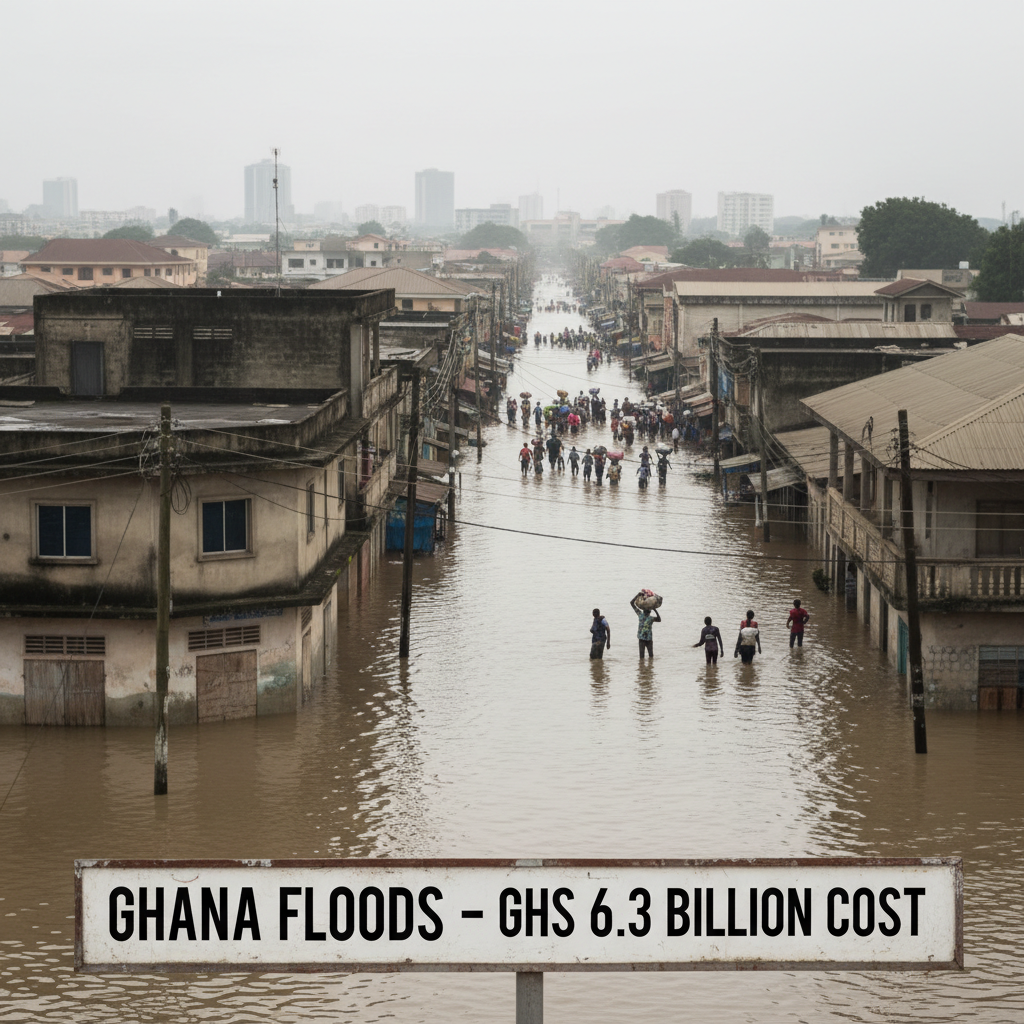
Urban flooding in Ghana, specifically within the Greater Accra Metropolitan Area, has caused economic losses exceeding GHS 6.3 billion between 2015 and 2025. This significant amount includes GHS 1.8 billion in damages to small and medium-sized enterprises, GHS 2.1 billion in destroyed public infrastructure, and GHS 800 million in residential property harm. These figures underscore the severe financial burden recurrent floods place on the nation's capital.
These persistent losses demonstrate that flooding is no longer merely an environmental concern but a fundamental governance challenge. Weak enforcement of planning regulations, inadequate sanitation systems, and institutional fragmentation contribute to the crisis. For example, recent floods in June 2026 submerged communities like Kaneshie and Adabraka, affecting approximately 3,000 residents in the Odawna area and causing 13 fatalities.
Ghana nationally loses an estimated USD 200 million annually to natural disasters, equivalent to nearly 2 percent of its Gross Domestic Product (GDP). More than 2 million people are affected each year by these events. The Greater Accra Resilient and Integrated Development (GARID) Project, a World Bank initiative, was approved at USD 350 million to mitigate flooding in the Odaw Basin. However, USD 65 million of this funding was reallocated to Ghana's COVID-19 response. By June 2025, USD 118 million out of USD 127 million drawn down had been spent, yet severe flooding continues in many of the targeted communities.
Dr. Victor Doke and Dr. Rebecca Y. Akatue, researchers from MyJoyOnline, highlight that these recurring disasters expose the vulnerability of Accra's urban landscape. They emphasize that the issue stems from a persistent disconnect between municipal planning authorities and informal land allocation. This institutional divide allows construction in wetlands and natural waterways, diverting floodwaters into neighboring communities.
Decision-makers must address the fragmented institutional responsibilities and weak enforcement of building regulations. Around 70 percent of Accra's primary drainage channels are heavily silted with refuse, reducing their capacity by nearly 50 percent. Furthermore, only about 35 percent of buildings in Accra possess approved permits, and less than 20 percent of structures are inspected annually. Improved coordination and stricter adherence to regulations are crucial to mitigate future economic and human costs. Watch for initiatives aimed at reinforcing urban planning and waste management to curb these escalating losses.