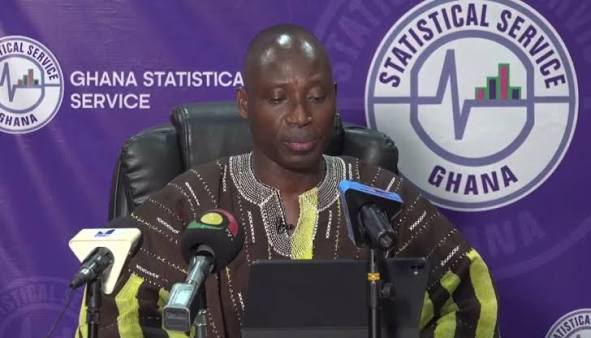
Ghana’s economy expanded by 5.10% year-on-year in May 2026. This growth extends the country’s recovery, with the services sector remaining the primary driver of economic activity.
The latest Monthly Indicator of Economic Growth (MIEG) from the Ghana Statistical Service (GSS) shows this expansion. It follows a 4.70% growth recorded in April, suggesting a modest strengthening of activity. However, performance remained uneven across different sectors of the economy.
This continued growth fits into a broader narrative of Ghana’s economic recovery. The economy expanded by 6.40% in the first quarter of 2026, surpassing the 6.20% from the same period in 2025. The services sector contributed significantly, accounting for 48.30% of overall Gross Domestic Product (GDP) growth in Q1 2026. This highlights its crucial role in the nation’s economic trajectory.
The Ghana Statistical Service describes the MIEG as a high-frequency indicator. It tracks economic performance monthly, providing early insights into quarterly GDP trends. This tool helps identify changes in economic momentum before full national accounts are released, offering timely data for analysis.
The strong performance of the services sector in May reinforces a pattern already visible in quarterly data. Information and communication, for instance, grew by 25.20% in the first quarter. Transport and storage expanded by 13.00%, and trade advanced by 9.00%. The industry sector also recorded robust growth of 6.90%, largely supported by a 10.70% increase in mining and quarrying activities.
For Ghana, the dominance of services is economically significant. This sector now accounts for a large share of national output and employment. Activities in telecommunications, finance, commerce, transport, and professional services increasingly dictate the pace of overall economic expansion. This shift reflects a modernizing economy, but also poses questions about balanced growth.
However, the agricultural sector presents an important weakness. Agriculture grew by 4.00% in the first quarter, significantly below the pace of many service and industrial activities. While crop production expanded by 4.70%, the fishing subsector contracted sharply by 18.50%. This illustrates the uneven performance within this vital sector.
Slower agricultural momentum has implications beyond its direct contribution to GDP. Agriculture is central to rural incomes, employment, food supply, and inflation control. Weak production can reduce household incomes in farming communities. It also increases the risk of food shortages and higher food prices, affecting the broader economy.
This becomes particularly important even as Ghana’s overall inflation environment has improved. Headline inflation stood at 3.70% in May, slightly up from 3.40% in April. However, it remained substantially below the 18.40% recorded a year earlier. Food inflation rose to 3.30%, with the Ghana Statistical Service citing domestic supply conditions as a key influence on prices.
The combination of strong services growth and weaker agriculture points to a broader question. This concerns the quality and sustainability of Ghana’s economic recovery. A growing services economy can support higher-value activities, digitalization, and formal-sector employment. This is especially true when growth is concentrated in areas like information technology and finance.
However, sustainable growth also requires stronger productivity in agriculture and manufacturing. This is essential if the recovery is to generate broad employment, contain food inflation, and reduce dependence on imported goods. Policymakers must address these sectoral imbalances to ensure inclusive economic progress.
The monthly data, while useful, should be interpreted cautiously. The MIEG is an indicator of economic activity, not a replacement for quarterly GDP figures. Monthly growth can fluctuate considerably due to changes in production, commodity exports, and sector-specific conditions. This volatility has been visible throughout 2026.
Economic activity expanded by 6.10% in January, accelerated to 7.70% in February, then eased to 5.40% in March. It moderated further to 4.70% in April before improving to 5.10% in May. This sequence suggests an economy growing at a healthy pace, but without uniform acceleration. For policymakers, the critical question is whether the strength in services can spread into productive sectors capable of creating many jobs. Ghana’s improving macroeconomic environment provides a supportive foundation for this transition.