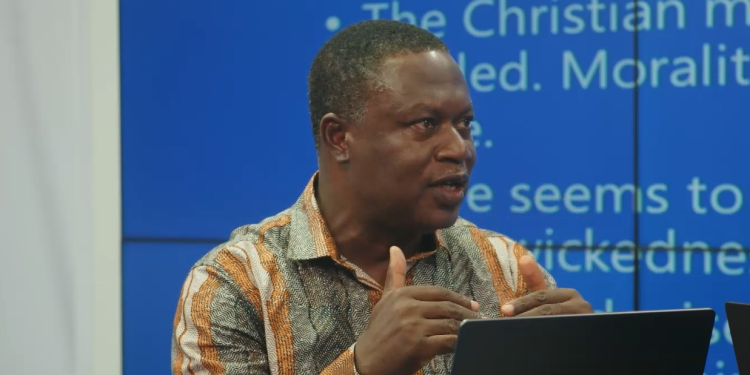
Professor Charles Ackah, a Research Fellow at the Institute of Statistical, Social and Economic Research (ISSER), has identified five key structural weaknesses that have consistently undermined Ghana's economy over the past 65 years. These challenges include persistent high inflation, an over-reliance on primary commodity exports, an underperforming agricultural sector, a weak manufacturing base, and slow industrialisation.
These issues have persisted despite interventions from various administrations, including both the New Patriotic Party (NPP) and the National Democratic Congress (NDC). Professor Ackah argues that these deep-seated problems prevent Ghana from achieving sustainable economic growth and resilience. The country's economic structure remains vulnerable to external shocks due to these unaddressed fundamental flaws.
Ghana's economic narrative has long been characterised by these recurring challenges, impacting its overall development trajectory. For instance, the nation has consistently struggled with high inflation rates, often exceeding regional averages, which erodes purchasing power and discourages long-term investment. This inflationary pressure has been a stubborn feature of the economy, despite the Bank of Ghana's efforts to maintain price stability through various monetary policies. The reliance on primary commodities like gold and crude oil also exposes Ghana to volatile global market prices, making national revenue unpredictable.
Professor Ackah stated, "Whether it is the NPP or the NDC, over the last 65 years, it has been chronically established. When you look at the data, the first one is inflation. We are among the economies with high inflation over 65 years despite all that the central bank has been doing. We are a high-inflation economy, and it is stubborn." He emphasised that this long-standing issue highlights a fundamental structural problem rather than a short-term policy failure.
Looking ahead, addressing these structural weaknesses will require comprehensive and sustained policy reforms. Decision-makers must focus on diversifying the economy, strengthening the agricultural and manufacturing sectors, and fostering industrialisation to reduce dependence on primary exports. The performance of the cedi, Ghana's currency, and its impact on import costs for manufacturers will be a critical indicator of progress. Investors and international partners will closely monitor the government's commitment to long-term structural changes over short-term fixes.
The poor performance of agriculture directly impacts manufacturing, as the former provides raw materials and consumer purchasing power. A weak agricultural sector forces manufacturers to import inputs, increasing production costs and reducing competitiveness. This situation is exacerbated by exchange rate challenges, which further diminish the competitiveness of local manufacturers. Consequently, many factories operate below capacity, and some even face closure, hindering job creation and economic expansion. Effective policy implementation targeting these interconnected sectors is crucial for Ghana's economic future.