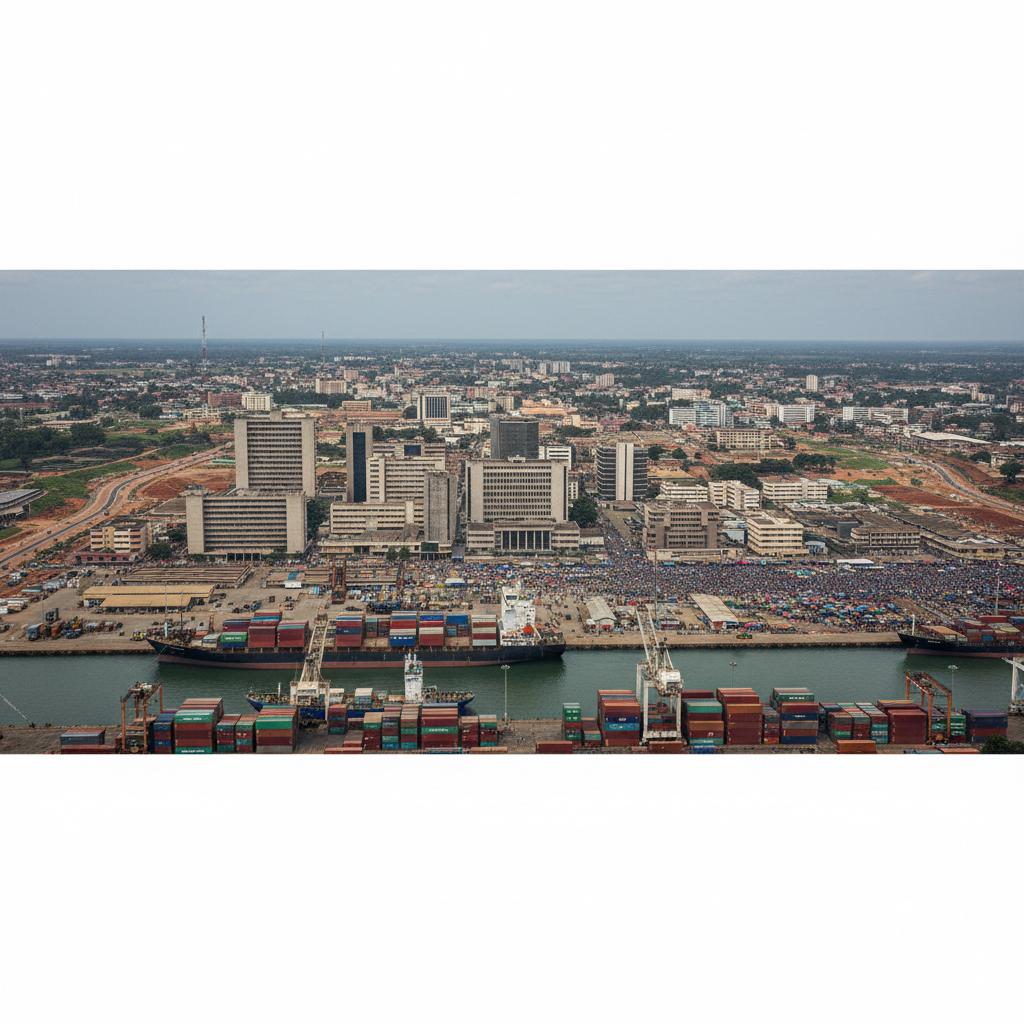
Emerging Markets Advisory Limited has proposed restructuring Ghana's economic landscape. The policy advisory firm argues that Accra's high concentration of economic opportunities causes recurring challenges. These challenges include flooding, traffic congestion, and housing shortages. This situation also places mounting pressure on public infrastructure.
EM Advisory's presentation, titled "Decongest the Economy, Decongest Accra: A Tri-Pole Economy Model for Ghana," states that engineering solutions alone cannot fix Accra's urban problems. The firm believes economic opportunities must be deliberately decentralised. Recent heavy rains, which caused widespread flooding in Accra, highlighted the capital's vulnerability and the deeper structural issue.
This proposal fits into Ghana's ongoing urban development and regional inequality discussions. Accra's rapid growth has long strained city services and infrastructure. Figures from the Ghana Statistical Service’s recent Population and Housing Census show Greater Accra is home to approximately 5.5 million people. This accounts for about 18 percent of Ghana's population. The region covers only 3,245 square kilometres, leading to a population density of roughly 1,681 people per square kilometre. This density is nearly twelve times the national average. By comparison, Bangladesh, a highly dense sovereign state, has an average density of about 1,500 people per square kilometre.
Dr. Abudu Abdul-Ganiyu, Managing Partner at Emerging Markets Advisory Limited, stated, "Accra's floods, traffic, and housing crisis are not primarily engineering failures. They are economic symptoms." He added Ghana has spent years treating the consequences of over-concentration. The actual underlying cause of economic over-concentration remains unaddressed. People migrate to Accra in search of jobs, worsening congestion despite infrastructure improvements.
The push for a tri-pole economy aims to create new growth poles beyond Accra. This would redistribute economic activity and alleviate pressure on the capital. Decision-makers may consider this strategy to address urban sprawl and regional disparities. This could also lead to new investments in infrastructure and industries in other regions. Such a shift would impact economic planning and resource allocation across Ghana.
EM Advisory's report highlights that over 70 percent of people migrating to Accra do so for employment and economic survival. This migration has transformed the city into a sprawling metropolitan area with rapidly expanding informal settlements. The relentless demand for a "piece of Accra" has often ignored environmental planning and physical limitations. Greater Accra and the Ashanti Region together account for nearly two-fifths of Ghana's population. Greater Accra occupies a significantly smaller land area.
Accra continues to absorb a disproportionately large share of national employment opportunities. It registers a positive employment-pull gap of about two percentage points, the highest in Ghana. In contrast, northern regions like Upper East, Northern, Upper West, North East, and Savannah face negative employment-pull gaps. These regions have considerably fewer job opportunities relative to their working-age populations. This disparity contributes to high unemployment rates in these northern regions, with Savannah at 22.4 percent, Upper East at 21.1 percent, and North East at 20.7 percent. These rates are roughly double Accra's unemployment rate. Addressing these economic imbalances is crucial for Ghana's equitable development.