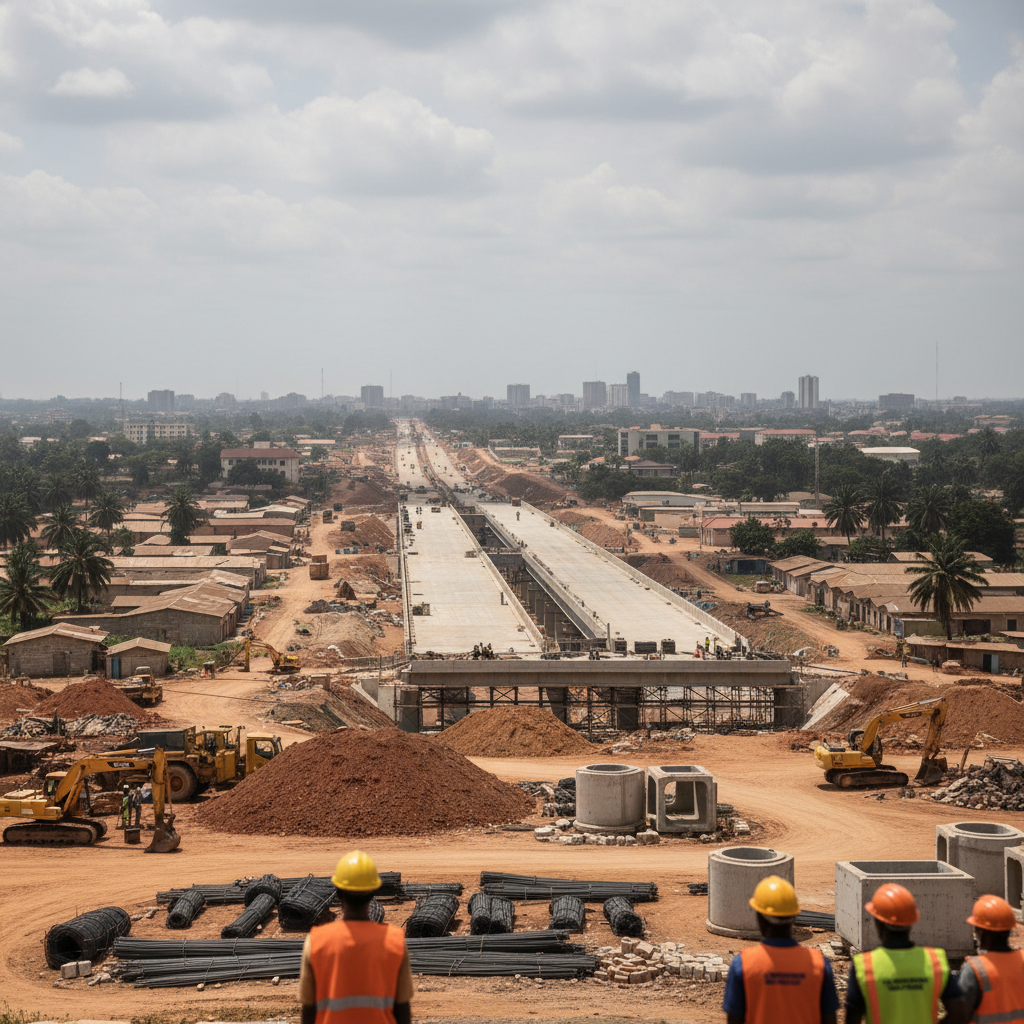
Ghana's Public Interest and Accountability Committee (PIAC) warns that volatile revenues from the country's oil and mineral sectors threaten the planned Kumasi-Accra Expressway project. PIAC Executive Secretary Isaac Dwamena stated that relying heavily on these fluctuating revenues for major infrastructure creates significant financial risks. Commodity price drops could delay or halt the project's implementation.
This vulnerability stems from Ghana's extensive reliance on petroleum and mineral revenues to finance large-scale developments. Historically, global oil and mineral price fluctuations directly impact Ghana's government income. Such instability makes it precarious to fund capital-intensive projects solely through these sources. The Kumasi-Accra Expressway is a key infrastructure initiative.
This situation highlights a recurring challenge within Ghana's economic framework, especially concerning public finance management. The PIAC 2025 Report shows that petroleum revenues have experienced periodic instability. Annual inflows consistently rise and fall with changes in global prices and production levels. The Ghana Extractive Industries Transparency Initiative (EITI) 2023 Report also confirms the extractive sector's susceptibility to external market conditions. This trend affects Ghana's ability to maintain a stable budget and fund long-term projects.
Isaac Dwamena emphasized these concerns at a capacity-building workshop for journalists. He warned against using a single source of funding for essential projects. Mr. Dwamena stressed the need for prudent financial planning and greater diversification of revenue sources. He referenced the PIAC 2025 Report's findings on petroleum revenue instability.
The implications of this dependence are significant for Ghana's economic stability and development agenda. Future commodity price shocks could severely impact ongoing and planned infrastructure projects. Decision-makers must now consider alternative, more stable funding mechanisms for major projects. Markets will closely watch how the government addresses these financing risks. Stricter enforcement of petroleum revenue management laws will become crucial to minimize financial leakages.
Mr. Dwamena acknowledged the government's strategy to focus extractive revenues on fewer high-impact projects. He described this prioritization, including the Kumasi-Accra Expressway, as an efficient use of public resources. This approach aims for greater value for money and visible development outcomes. However, he cautioned that infrastructure spending alone is insufficient for long-term economic resilience.
He urged for greater diversification in how extractive revenues are used. Strategic investments capable of generating long-term returns are essential. Mr. Dwamena cited the 30 million dollar investment in Kotoka International Airport expansion as a successful example, generating over 17 million dollars in returns. Similar investments could create sustainable revenue streams, protecting the economy from commodity price shocks. This approach would build a more robust financial foundation.
PIAC also raised concerns about enforcing existing petroleum revenue management laws. Misapplication of funds and weak accountability remain issues. Stricter compliance with the legal framework is necessary to ensure public funds serve their intended purposes. This helps to minimize leakages and maximize the benefits from natural resources. Improved oversight and transparency are vital for Ghana's financial health.
Mr. Dwamena called on the media to enhance its capacity to report on the extractive sector. A well-informed and equipped media plays a critical role in promoting transparency and accountability. This helps safeguard public interest and ensures Ghana derives maximum value from its natural resources. Such vigilance strengthens democratic oversight.