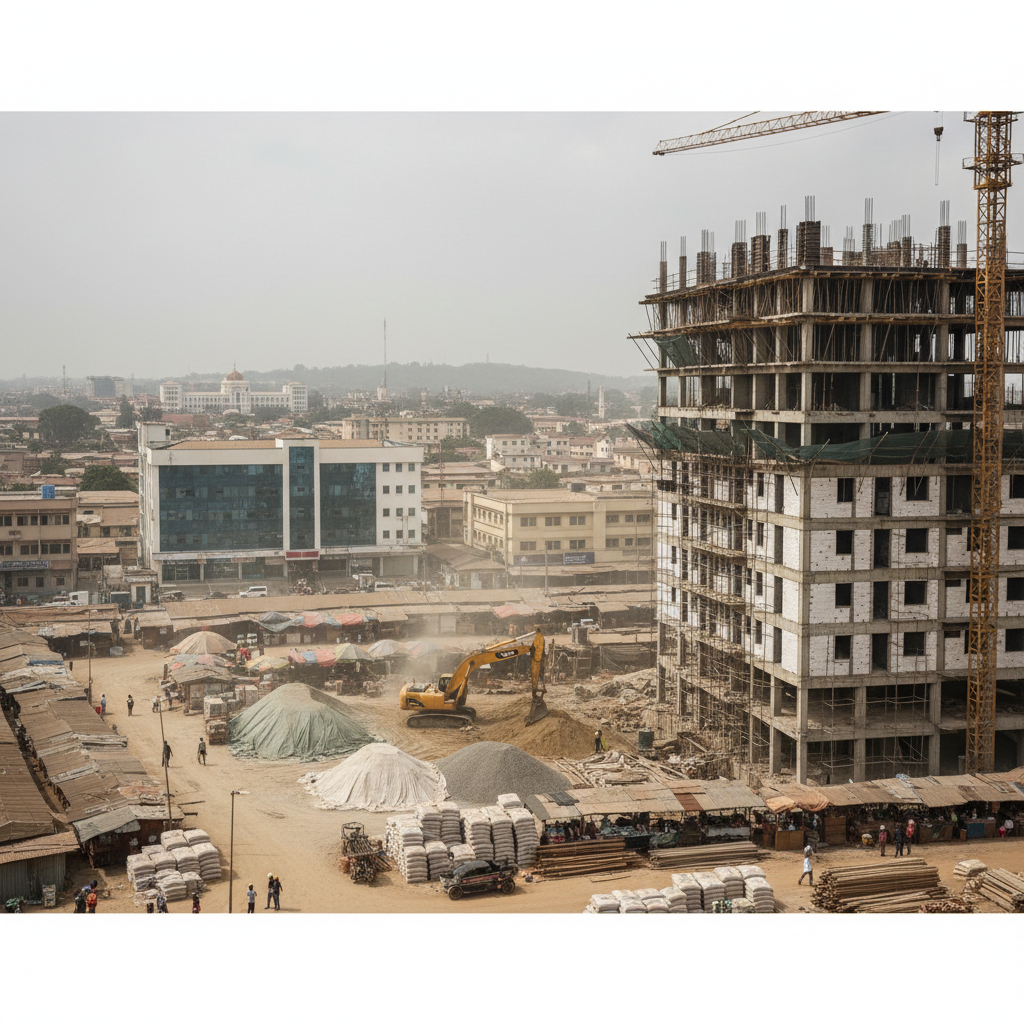
Ghana’s building cost inflation increased slightly to 2.7% in May 2026, according to the latest Prime Building Cost Index (PBCI) from the Ghana Statistical Service (GSS). This marks a marginal rise from 2.2% recorded in April.
Material and plant costs primarily drove this increase, even as labour costs continued to decline. The GSS data indicates that building materials, which make up 76.5% of the PBCI, saw their inflation rate rise to 3.5% in May from 2.4% in April. Plant costs, including equipment, recorded a significant jump from 4.7% in April to 9.8% in May. This upward trend in key input prices affects investors, contractors, and developers.
This slight uptick occurs within a larger context of significantly reduced inflation compared to the 22.0% in May 2025. The overall easing of price pressures aligns with the broader economic narrative of Ghana, where inflation has been a persistent challenge. The PBCI, indexed to a 2023 base year, offers a vital indicator of construction sector health, impacting investment decisions and national development initiatives like the “Big Push” agenda. The report also shows overall building input prices rose 1.4% month-on-month between April and May 2026.
Dr. Alhassan Iddrisu, the Government Statistician, highlighted these figures. The data provides critical insights for policymakers and industry stakeholders. It tracks changes in prices for essential components such as building materials, labour, and equipment. The report was copied to The Ghanaian Times in Accra yesterday.
Looking ahead, prospective homeowners might find this a strategic time to initiate or restart construction projects as material prices stabilise. Businesses are advised to secure medium-term supply contracts to lock in current prices and mitigate future cost increases. The government may need to accelerate infrastructure projects and expand skills training to strengthen the construction workforce. This will address labour cost fluctuations and maintain sector stability.
Plumbing materials recorded the highest year-on-year inflation rate at 22.8% among sub-groups. In contrast, cement experienced the lowest at a negative 14.5% inflation. Labour costs continued their decline, registering a negative 2.0% year-on-year inflation rate in May, down from 1.0% in April. Both skilled and unskilled labour saw reduced costs, with negative 1.7% and negative 2.6% inflation rates respectively. Specifically, month-on-month labour prices decreased by 0.6%. Fourteen of the 23 sub-groups tracked in the index showed inflation rates above the 2.7% national average for the sector.