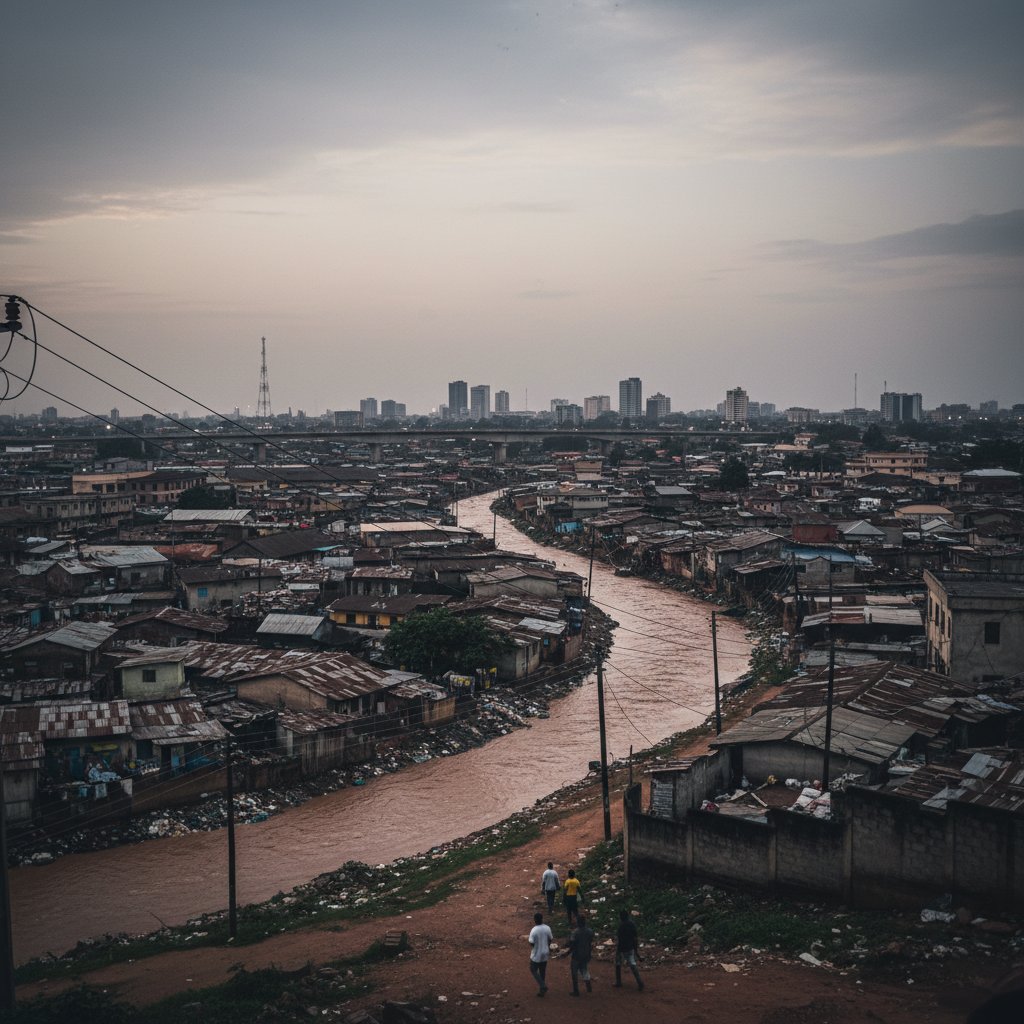
Accra faces escalating vulnerability to flooding as residents normalise risks, according to JoyNews journalist Jacqueline Ansomah Yeboah. This normalisation leads to settlement choices in low-lying areas, increasing the city's long-term exposure to flood events. These areas naturally function as drainage routes during heavy rainfall.
Ms. Yeboah, a participant in the Loud and Green X Spaces discussion, observed specific parts of Accra, such as Sampa Valley. This area has clear geographical indicators of high vulnerability to seasonal flooding. Despite these warnings, many residents continue to live there. They often rely on the absence of recent severe flooding as reassurance that the risk is minimal.
This trend fits into a broader pattern where perceived safety overrides environmental understanding. The normalisation of risk creates a disconnect between environmental reality and everyday decision-making. If a location has not experienced recent major flooding, the perceived danger diminishes over time. This happens even when the physical terrain clearly suggests otherwise. This phenomenon contributes to Accra's recurring flood challenges, which are not solely due to infrastructure gaps.
Ms. Yeboah stated, "People are normalising risk because nothing has happened yet." This statement captures a significant concern regarding flood-prone environments. These areas are gradually redefined as safe simply because a disaster has not recently occurred. This creates a "delayed awareness" cycle. Risk is only acknowledged after extreme rainfall events trigger visible destruction.
By this point, households, infrastructure, and livelihoods are already exposed. This makes recovery significantly more difficult and costly. The journalist warned that this gap between perception and environmental classification is a critical, yet under-examined, driver of Accra's flood problems. Unlike drainage capacity or infrastructure design, perception shapes settlement patterns long before formal planning systems intervene.
Where people choose to build is often influenced by social experience and affordability. It is less influenced by hazard maps or hydrological data. Benedict Atta Poku, a Petrochemical Engineer, reinforced this view. He noted that even well-designed drainage systems can fail when their flow paths are obstructed. Water movement is governed by natural laws, which cannot be overridden by settlement patterns alone.
Accra’s flood risk is therefore not driven solely by infrastructure gaps. It results from the interaction between perception, planning, and environmental reality. Until these three elements are aligned, urban expansion will continue into natural flood pathways. This cycle repeatedly overlooks risk until extreme weather makes it impossible to ignore. The challenge is not only to build better drainage systems. It is also to ensure communities, planners, and policymakers recognise flood pathways before development locks people into them.