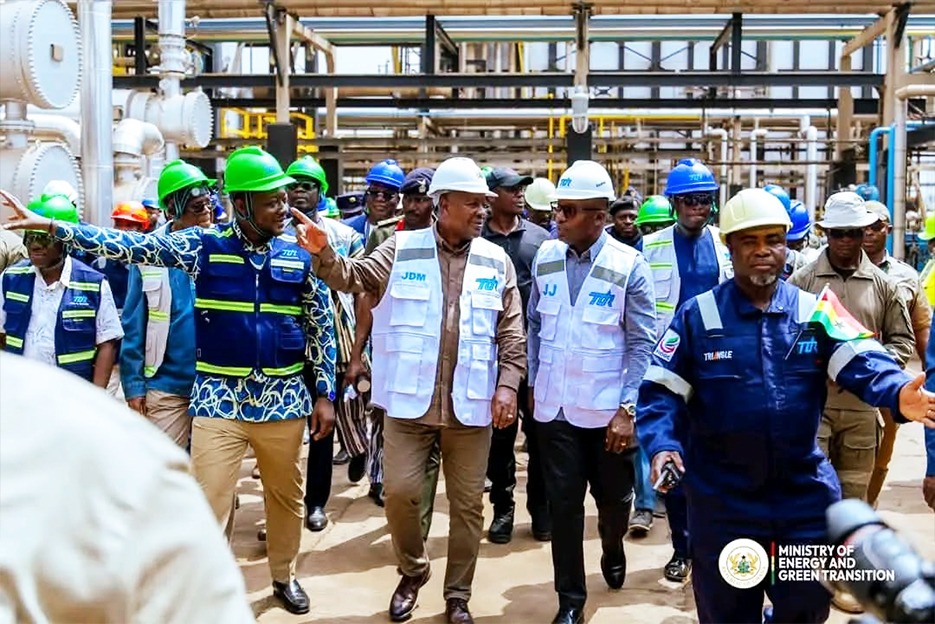
President John Dramani Mahama has officially commissioned the refurbished Crude Distillation Unit (CDU) at the Tema Oil Refinery (TOR). This significant event, which occurred over the weekend, marks a crucial step in the government's "Energy Sector Reset Agenda" and aims to restore TOR's operational capacity.
The revitalisation of the CDU, considered the "heart" of the refinery, was funded entirely through internally generated funds, amounting to GHS 264 million (22 million dollars). This funding approach avoided external debt, showcasing a commitment to financial prudence. The project included tank rehabilitation, logistics improvements, and upgraded staff transportation, moving TOR away from its previous state of dormancy.
This intervention is part of a broader strategy to integrate TOR into Ghana's economic fabric, reducing the nation's heavy dependence on imported refined petroleum products. The refinery's previous inactivity had made it a "white elephant," struggling under a private operating arrangement that failed to deliver. The current administration chose to rebuild TOR as a strategic national asset rather than leasing it out, a path many state-owned enterprises have taken.
Dr. John Abdulai Jinapor, the Minister for Energy and Green Transition, confirmed he halted a pending 10-year lease of the refinery for 22 million dollars due to a lack of parliamentary approval. He praised Managing Director Edmond Kombat and his team for independently raising the same 22 million dollars to fund the revamp. This internal funding demonstrates a strong commitment to national self-reliance and efficient resource management.
The recommissioning is expected to restore investor confidence and enable Ghana to refine its own domestic crude oil locally. This move will play a critical role in advancing the President’s "24-Hour Economy" and the broader "Reset Agenda." A comprehensive roadmap is in place to expand TOR’s refining capacity to 100,000 barrels per day in the near future, aiming to position Ghana as a petroleum hub for the West African sub-region.
Dr. Abdulah Salifu of UNICOF, representing the refinery's workforce, highlighted the resilience of staff who resisted the facility's degradation. He expressed gratitude for policy-guided initiatives that have resulted in the promotion of 260 workers and salary increments. The staff union has appealed for government intervention to address TOR’s legacy debt and integrate it into the country’s upstream crude oil supply for long-term profitability. They also proposed listing the refinery on the Ghana Stock Exchange to restructure ownership and protect the asset from future mismanagement.
The successful refurbishment of the CDU signifies a renewed focus on national assets and energy security. The ability to refine crude oil domestically will have positive implications for Ghana's balance of payments and overall economic stability. Future developments will likely focus on the expansion of refining capacity and the resolution of legacy debts to ensure TOR's sustained profitability and strategic importance.