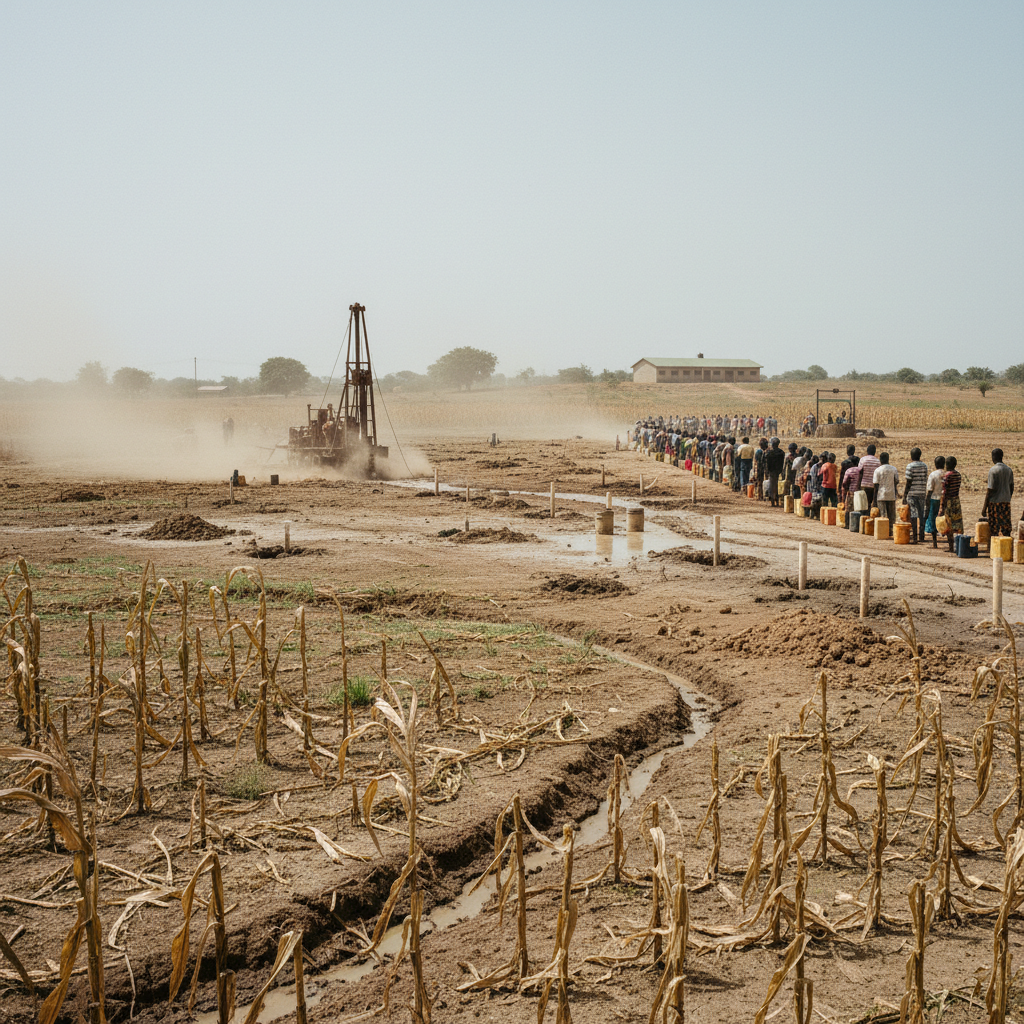
Ghana confronts a silent environmental crisis involving the uncontrolled drilling of boreholes across the country. Professor Yvonne Sena Akosua Loh has coined this alarming practice 'Groundwater Galamsey.' This refers to the unscientific and poorly documented extraction of groundwater without essential hydrogeological investigations.
This unregulated activity bypasses crucial steps such as professional supervision, water-quality testing, and proper data submission for national planning. The proliferation of these unauthorized boreholes directly threatens Ghana's vital national water security framework. It places homes, schools, farms, businesses, and public health at considerable risk.
This development unfolds against a backdrop of increasing demand for alternative water sources due to an often unreliable public water supply. Many households, churches, schools, and businesses now depend on private boreholes for their daily water needs. The surge in demand has fostered a lucrative but largely unregulated private drilling industry across Ghana. This trend, while addressing immediate water access gaps, creates significant long-term risks for the nation's most critical natural resource.
Professor Yvonne Sena Akosua Loh emphasized the scientific complexity of groundwater extraction. She stated, "Drilling is not merely a mechanical activity; it is a scientific and engineering process." This process requires deep knowledge of hydrogeology, geophysics, and environmental protection. Without this expert understanding, borehole drilling becomes a dangerous gamble with wide-ranging consequences.
The immediate implication is a severe degradation of Ghana's precious groundwater reserves, an essential component of the nation's natural capital. Decision-makers must urgently implement stringent regulations and monitoring systems for borehole drilling. Markets and communities will increasingly face the financial and health costs associated with water scarcity and contamination if the current trajectory continues. The absence of proper testing means consumers may unknowingly use contaminated water, leading to public health emergencies.
Groundwater is a hidden, but not unlimited, resource. Every borehole taps into a larger natural system. Misuse of this system extends beyond individual households to affect entire communities and regions. Improperly sited or constructed boreholes can allow surface contaminants to seep into aquifers, posing severe health risks. Drilling too many boreholes close together can also deplete aquifers faster than they can recharge, leading to water shortages.
Furthermore, boreholes drilled without scientific planning may fail to produce sufficient water or may dry up prematurely. The lack of proper testing means drinking water may contain harmful substances like nitrate, fluoride, arsenic, or lead, even if it looks visibly clear. This silent crisis demands immediate attention to safeguard Ghana's water resources for future generations. Preventing a national water crisis requires comprehensive regulatory reform and rigorous enforcement.