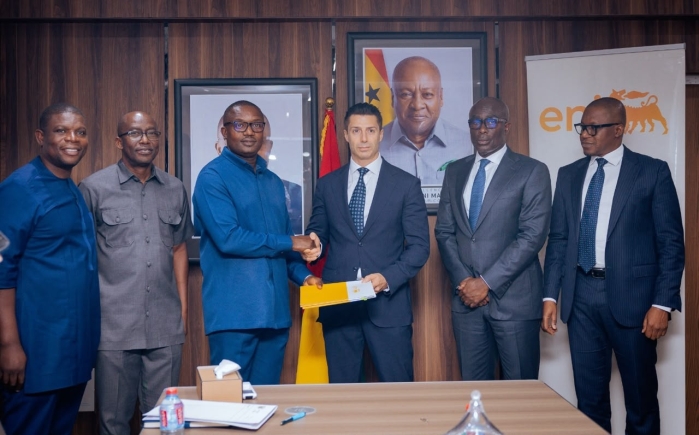
Eni Ghana and Vitol Upstream Tano Limited have signed two Memoranda of Understanding with the Government of Ghana. These agreements cover offshore blocks GH WB 3 and GH WB 8 in the Tano Basin. This action paves the way for final petroleum agreements, marking a key step in expanding Ghana's upstream petroleum sector.
The signing ceremony took place in Accra on Thursday, September 10, 2026. The Minister for Energy and Green Transition, Honourable John Jinapor, signed on behalf of the Government of Ghana. Executives from the Ghana National Petroleum Corporation witnessed this important event. This development follows a Memorandum of Intent signed last year, showing continued commitment.
This move is crucial for Ghana's economic future, especially its upstream petroleum sector. Expanding oil and gas exploration can boost national revenue and energy security. Ghana has been working to attract foreign investment in its natural resources. These agreements align with the nation's long-term energy strategy. The Tano Basin is a known hydrocarbon-rich area, making these blocks strategically important.
The company stated these opportunities fit Eni's near-field and Infrastructure-Led Exploration strategy. This approach uses existing infrastructure and nearby producing areas. It aims to unlock the potential of new prospective zones efficiently. Eni has been active in Ghana since 2009, undertaking offshore hydrocarbon exploration and production. The firm currently holds an equity production of approximately 40,000 barrels of oil equivalent per day.
Eni operates the Offshore Cape Three Points project with a 44.4 per cent stake. Vitol holds 35.6 per cent in this project. The Ghana National Petroleum Corporation controls the remaining 20 per cent. This partnership model is common in Ghana's petroleum industry. It ensures local participation and expertise alongside international investment. Such collaborations are vital for technology transfer and capacity building.
The two new blocks span an area of approximately 2,100 square kilometres. Water depths in these areas range from 750 to 2,800 metres. Exploring and developing these deepwater blocks requires significant capital investment and advanced technology. The commitment from Eni and Vitol signals confidence in Ghana's geological prospects and regulatory environment. This also reflects a broader trend of international energy companies seeking new frontiers.
Beyond core operations, the joint venture also invests in community development. Their portfolio includes initiatives in training and economic diversification. They also support access to water, sanitation, and energy. This reflects a broader commitment to sustainable investment. Such social responsibility efforts are increasingly important for securing operational licenses. They also help build positive relationships with local communities.
The finalisation of these petroleum agreements will likely attract further interest in Ghana's energy sector. It signals stability and opportunity for investors. The government will need to ensure transparent and efficient regulatory processes. This will maximise the benefits for the Ghanaian economy. Watch for further announcements regarding exploration plans and investment timelines. These will shape Ghana's energy landscape for years to come.