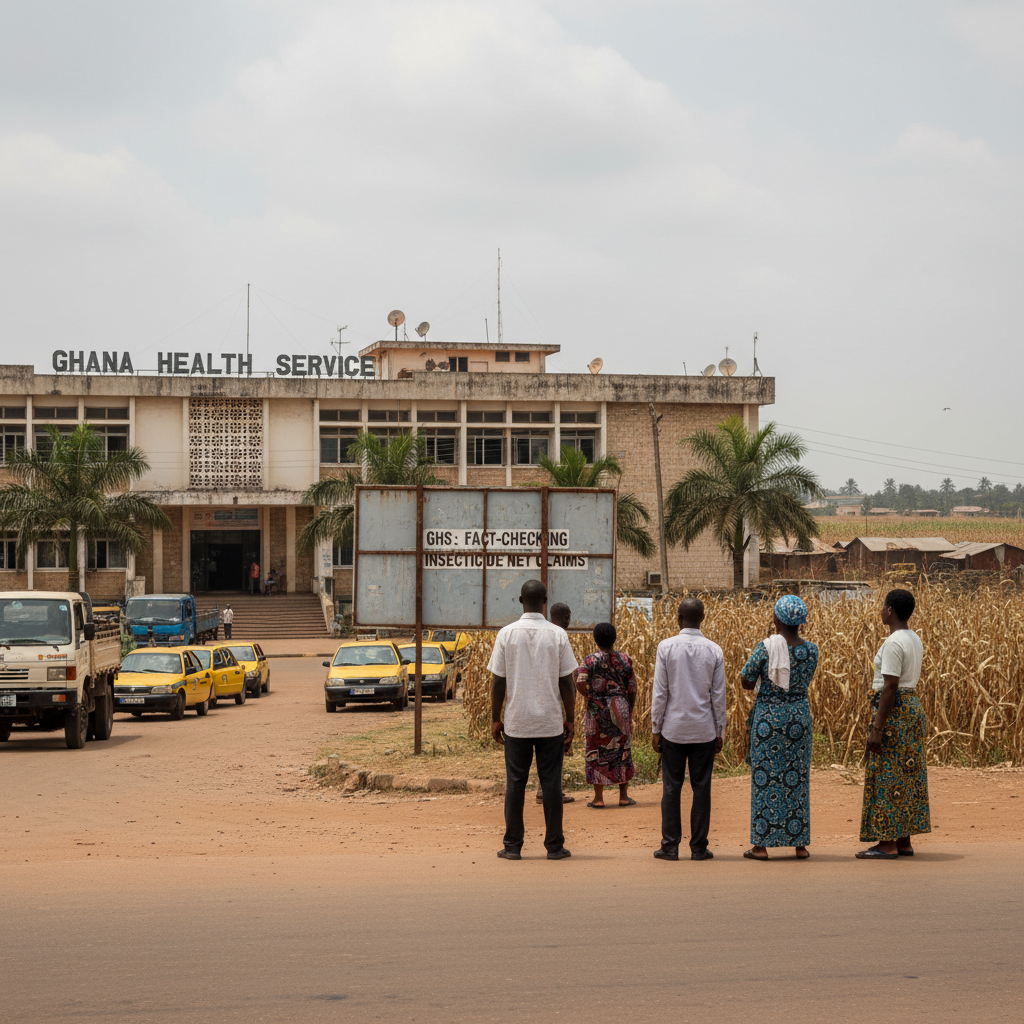
The Ghana Health Service (GHS) has dismissed claims that insecticide-treated nets (ITNs) distributed to primary school children contain harmful chemicals. In a statement released on June 26, the GHS categorically stated these allegations are false and misleading.
These widely circulated social media claims suggested the nets pose risks to human health. The GHS has urged parents and the general public not to be alarmed. It insists the nets have undergone rigorous safety testing and received approval from both national and international regulatory authorities.
This rebuttal comes as Ghana intensifies its fight against malaria, a leading cause of illness and death, especially among children. Public trust in health interventions is critical for their success. Misinformation can undermine efforts to protect vulnerable populations from preventable diseases like malaria.
“The claims were 'false, misleading and without any scientific or regulatory basis',” the GHS statement said. The GHS identified the nets as Interceptor® G2 Long-Lasting Insecticidal Nets (LLINs). The World Health Organisation (WHO) has approved these nets, which are part of Ghana's national malaria elimination programme.
The nets contain chlorfenapyr and alpha-cypermethrin, two insecticidal compounds. These compounds have been in use globally in public health programs for many years, according to the GHS. Health and regulatory authorities widely recognize their safety and effectiveness.
The Interceptor® G2 net is one of several WHO-prequalified ITNs used across Ghana and other African countries. The GHS addressed specific concerns about respiratory risks. It explained that the insecticides in these nets do not become airborne due. They have an extremely low vapour pressure and are very stable. This means people sleeping under these nets breathe normal air, not insecticide.
The GHS emphasized that ITNs have been used in Ghana and sub-Saharan Africa for decades. No documented cases of respiratory illness have ever been linked to their proper use during this period. The Food and Drugs Authority (FDA) also approved the Interceptor® G2 net before its distribution.
All ITNs undergo extensive safety assessments before public use. These assessments cover all population groups, including children, pregnant women, and infants. The Ghana Health Service appealed to parents, caregivers, and communities to continue using the nets. This protection is vital against malaria, which remains a significant public health challenge in Ghana.
Users should air newly received nets in a shaded, well-ventilated area for up to 48 hours. This allows any mild odour from the packaging to dissipate. The GHS also cautioned the public against spreading unverified health information online. Such misinformation causes unnecessary fear and puts children and everyone at risk.
The GHS encouraged individuals with concerns or unusual reactions to report them to the nearest health facility. It reaffirmed its commitment to public safety. Every ITN distributed under the national malaria program undergoes thorough testing and verification before reaching households.