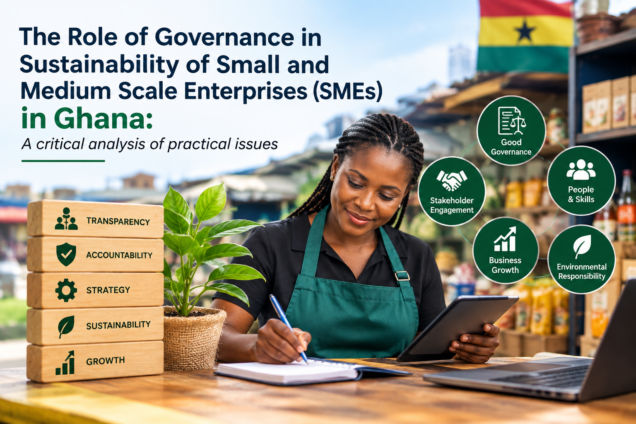
Poor governance practices directly undermine the sustainability of Small and Medium Scale Enterprises (SMEs) in Ghana. These issues prevent businesses from efficiently using resources, attracting necessary finance, and adapting to market changes.
A significant problem is the blurred line between an owner's personal finances and the business's money. Many owners use company revenue for household expenses before covering business costs, depleting working capital. This practice makes businesses vulnerable, especially since access to finance remains a major challenge for Ghanaian firms.
This situation is particularly critical because SMEs form the backbone of Ghana's economy. The World Bank's 2023 Enterprise Survey found that 52.5% of formal firms in Ghana are small, employing 5 to 19 workers, while 37.7% are medium-sized, with 20 to 99 workers. Only 9.8% are large businesses. This dominance means that SME health directly impacts national economic stability and job creation.
The Ghana Report highlights that governance in SMEs should focus on practical issues like financial control, decision-making processes, and risk management. It argues that effective governance reduces over-reliance on individuals and replaces informal habits with structured systems. This approach is more suitable than imposing complex corporate governance models on smaller firms.
One common practical problem is the concentration of ownership, management, and control in a single person. The founder often approves all purchases, negotiates with suppliers, and manages bank accounts. This centralisation slows operations as businesses grow, particularly when the owner is unavailable. For instance, a furniture manufacturer with 15 workers cannot scale if only the owner can approve timber purchases or sign cheques.
Good governance introduces controlled delegation, allowing managers to approve routine material requests within defined limits. For example, purchases below GHS 2,000 might be approved by an operations manager. Items between GHS 2,000 and GHS 10,000 could require both owner and manager approval. Larger purchases above GHS 10,000 would need documented quotations and additional review. Such systems ensure both speed and accountability, preventing fraud while enabling growth.
Financial governance is crucial for survival. When owners use business revenue for personal expenses, they consume working capital. For example, a retailer with GHS 80,000 in stock and GHS 120,000 in sales might see the sales as available cash. However, if replacing stock costs GHS 75,000 and operating expenses are GHS 25,000, only GHS 20,000 remains before taxes. If the owner takes GHS 40,000 for personal use, the business loses GHS 20,000 of its working capital. This is a clear governance failure.
Effective financial governance requires owners to receive a predetermined salary or drawing, ensuring retained earnings stay within the business. This separation protects the company's financial health. The World Bank Enterprise Survey identifies finance as a principal constraint for Ghanaian firms, alongside regulation, competition, corruption, and infrastructure. Improving governance can unlock better access to capital.
Policymakers and financial institutions must recognise the direct link between SME governance and economic resilience. Efforts to support SMEs should include training and resources for implementing appropriate governance structures. This will help businesses grow, create more jobs, and contribute more robustly to Ghana's economic development. Without these improvements, many promising Ghanaian businesses will continue to struggle for long-term survival.