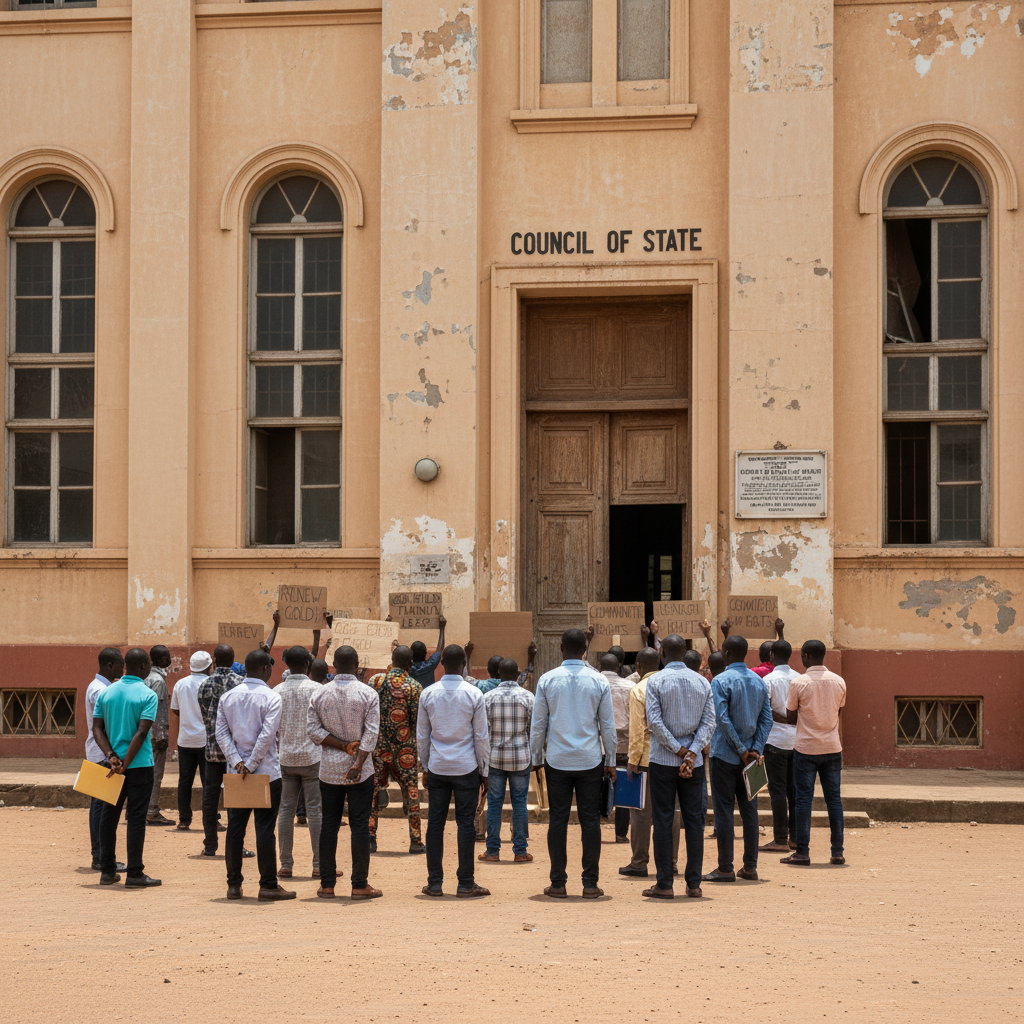
A Ghanaian private citizen has petitioned the Council of State to reject calls for refusing the renewal of Gold Fields Ghana Limited's Tarkwa mining lease. Public Financial Management Expert Derrick Opare Asamoah submitted the petition, warning that denying renewal could damage investor confidence and threaten local businesses.
Mr. Opare Asamoah's petition, dated July 1, 2026, officially reached the Council of State. It seeks the Council's advisory intervention amid increasing debate over the lease. This directly counters suggestions from organisations like the Institute of Economic Affairs (IEA).
The IEA previously urged the government to consider refusing the lease renewal. They proposed transferring the mining concession to Ghanaian ownership. The IEA argues that Ghana has not benefited enough from decades of mineral extraction. They cite the lack of development in mining communities despite Ghana being a top gold producer.
Mr. Opare Asamoah acknowledged valid concerns about Ghana's mining sector in his petition. He agreed that Ghana has fallen short in converting mineral wealth into widespread prosperity. He also supported the legitimate desire for greater national benefits from resources.
However, Opare Asamoah insisted that denying the Gold Fields lease is not the right solution. He stated, “The solution proposed – outright lease denial – would not address these concerns. It would deepen them.” Denying the lease could send negative signals to international investors.
The petitioner highlighted that the Tarkwa mine became a major asset through decades of investment. He noted that before Gold Fields acquired it in 1993, it was a struggling underground operation. The mine produced only 24,000 ounces annually under the State Gold Mining Corporation (SGMC). Gold Fields has since invested over GHS 5 billion, transforming Tarkwa into one of Africa’s largest open-pit gold operations. It now produces approximately 500,000 ounces annually.
“One question this honourable Council must consider is straightforward: does Ghana currently possess the capacity to take over and operate this mine successfully? With respect, the evidence says no,” the petition stated. Opare Asamoah strongly argued that Ghana lacks the capital and technical capacity for such a takeover.
He warned that international capital markets would view a lease denial as expropriation. This could prevent future financing for similar projects in Ghana. He stated, “To attempt such a transition without the requisite financial, technical, and institutional capacity is to invite operational collapse.”
The petition also stressed the importance of secure tenure for long-term mining investments. Ghana's Minerals and Mining Act aims to provide certainty for investors who meet their obligations. Without assurance of renewal, mining companies would reduce their investments in exploration and long-term capital projects. This would shorten mine life and hinder sustainable operations.
Beyond investor concerns, Mr. Opare Asamoah cited the impact on local businesses. He mentioned Ghanaian firms like Engineers and Planners and ZEN Petroleum Holdings. These companies have established commercial relationships within the Gold Fields supply chain. A lease denial would disrupt these supply chains, terminate contracts, and cause job losses.
He concluded that the Ghanaian businesses the IEA seeks to champion would be the first to suffer. Gold Fields has invested billions of GHS locally and supported infrastructure projects through its foundation. The company has funded projects such as the Tarkwa-Damang road and the T&A Stadium. This commitment to local content and value retention is crucial for the Ghanaian economy.