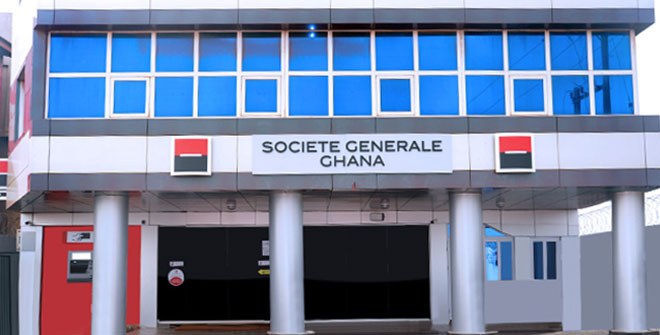
Societe Generale Ghana Plc recorded a significant 47.69% decline in profit after tax for the first half of 2026, settling at GHS 128.21 million. This figure is down from GHS 245.08 million reported in the same period of 2025. The Ghana Stock Exchange-listed bank also saw its profit before tax fall by 47.50% to GHS 198.37 million from GHS 377.86 million.
This sharp reduction in profitability occurred despite an expansion in customer loans and deposits. Weaker interest earnings and trading revenue were the primary drivers of this downturn. The bank's earnings per share also dropped from GHS 0.69 to GHS 0.36, reflecting the overall weaker financial performance.
The bank's performance highlights a broader challenge within Ghana's banking sector, where expanding balance sheets do not always translate into stronger earnings. The benefits of increased lending and deposit growth were offset by a significant contraction in interest income and rising operating costs. This trend could signal tighter margins for financial institutions in the current economic climate.
Interest income, the main source of revenue for most commercial banks, decreased by 27.82% to GHS 526.22 million from GHS 729.07 million. Although interest expenses also fell by 17.89% to GHS 93.36 million, this reduction was insufficient to compensate for the larger decline in income from loans and investments. Consequently, net interest income dropped by 29.66% to GHS 432.87 million from GHS 615.38 million.
This contraction in net interest income likely reflects lower yields on government securities and a shift in asset allocation, alongside a general reduction in market interest rates. While the unaudited statements did not provide a detailed explanation, these factors typically influence bank profitability. The impact was partially mitigated by stronger fee and commission earnings, which rose by 10.13% to GHS 88.48 million.
Net fee and commission income increased by 27.29% to GHS 55.80 million, indicating improved revenue from transactional banking and other fee-generating activities. However, this gain was too small to offset the substantial reduction in net interest income. Net trading revenue also weakened, falling by 33.62% to GHS 43.35 million.
Operating costs also contributed to the profit decline. Total operating expenses increased by 8.98% to GHS 356.05 million from GHS 326.70 million. Personnel expenses rose by 7.90% to GHS 158.30 million, and depreciation and amortisation increased by 23.71% to GHS 75.18 million. This combination of lower income and higher costs significantly weakened the bank's operating efficiency.
Societe Generale Ghana's cost-to-income ratio, a key measure of efficiency, worsened to approximately 65.33% from 49.17% a year earlier. This means the bank spent over GHS 0.65 to generate every GHS 1.00 of operating income, compared to about GHS 0.49 in the first half of 2025. This rising ratio signals that cost growth is outpacing revenue, requiring close attention from management.
Despite the earnings decline, the bank expanded its balance sheet. Total assets grew by 12.57% to GHS 10.97 billion from GHS 9.75 billion. Loans and advances to customers increased by 21.80% to GHS 4.65 billion from GHS 3.82 billion, indicating increased credit extension. Customer deposits also rose by 20.17% to GHS 6.84 billion from GHS 5.69 billion, providing additional funding for lending activities.
This shift in asset composition, moving from government securities towards customer lending, suggests a strategic reorientation. However, the immediate impact has been a significant reduction in profitability. Investors and analysts will closely monitor how the bank manages its cost structure and revenue diversification strategies in the coming quarters to improve its financial performance.