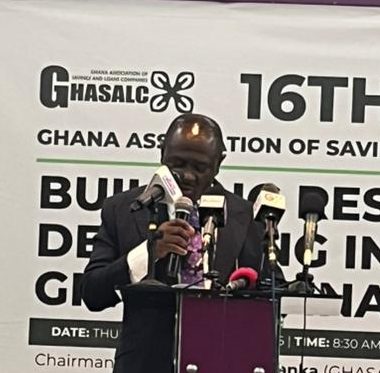
Ghana’s savings and loans industry supports the Bank of Ghana’s (BoG) proposed microfinance sector reforms. However, the industry warns that the transition must carefully reflect the capital, liquidity, and operational realities of institutions. This careful calibration is essential to strengthen the sector rather than destabilise it.
Dr. Fred Safo-Kantanka, Board Chairman of the Ghana Association of Savings and Loans Companies and Finance Houses (GHASALC), stated the industry accepts the need for stronger regulation. He highlighted the importance of better governance and more resilient institutions. Dr. Safo-Kantanka cautioned that the timing and implementation of these reforms are as crucial as their objectives. He described the impending overhaul as a significant regulatory shift for Ghana’s non-bank financial sector.
This endorsement from GHASALC is important because savings and loans companies play a vital role in Ghana’s financial system. They serve households, traders, micro-enterprises, and small businesses. These entities often do not fit the risk appetite or operating models of traditional commercial banks. Therefore, the reform debate extends beyond tightening prudential standards. It also concerns how regulation affects credit flow to critical economic segments.
“The Association recognises and supports the intent and objectives of the reforms,” Dr. Safo-Kantanka said at GHASALC’s 16th Annual General Meeting. He added, “We appreciate the need to strengthen the regulatory framework, improve institutional resilience, enhance governance and risk management, deepen financial inclusion and create a more sustainable microfinance industry.” This statement underscores the industry's commitment to a robust financial environment.
GHASALC’s position is that while stronger regulation is necessary, poorly sequenced reform could reduce the number of viable institutions. This could constrain access to finance and place employment at risk. The warning highlights a policy dilemma for the Bank of Ghana. A stronger regulatory framework can improve confidence and reduce institutional fragility. However, stricter capital and liquidity requirements can be disruptive if institutions must recapitalise too quickly.
This is particularly true in a sector serving customers with smaller, more informal, and geographically dispersed financing needs. These needs differ from those typically targeted by universal banks. If reforms lead to widespread consolidation or exit without adequate transition arrangements, the result could be a stronger sector on paper but a narrower one in practice. This would undermine the goal of financial inclusion.
GHASALC argues that the success of the reforms should not be judged solely by whether regulatory thresholds are raised. Success should also be measured by whether institutions are genuinely strengthened under the new framework. “Our position has not been one of resistance to reform, but rather shaping it to achieve the intended objectives without jeopardising the entire sector,” Dr. Safo-Kantanka explained. He pointed to the realities of long-operating institutions, capital and liquidity constraints, potential job impacts, and the need for an orderly transition.
He further stated, “We believe that successful reform is not merely about changing the regulatory structure; it is about building stronger institutions within that structure.” This distinction is central to the debate. Regulation can improve resilience only if institutions possess the financial capacity, governance systems, technology, and management depth to comply sustainably. If compliance costs rise faster than institutions can adapt, reforms may unintentionally accelerate closures, mergers, or retrenchments.
For Ghana, the stakes extend beyond the financial sector itself. Micro, small, and medium-sized enterprises (MSMEs) heavily rely on alternative forms of credit and savings intermediation. Any contraction in this financing ecosystem could affect working capital, business expansion, and employment. This impact would be particularly felt among firms outside mainstream bank lending. GHASALC is already preparing for the possibility that the reforms will fundamentally redraw the institutional landscape, necessitating careful planning and adaptation across the sector.