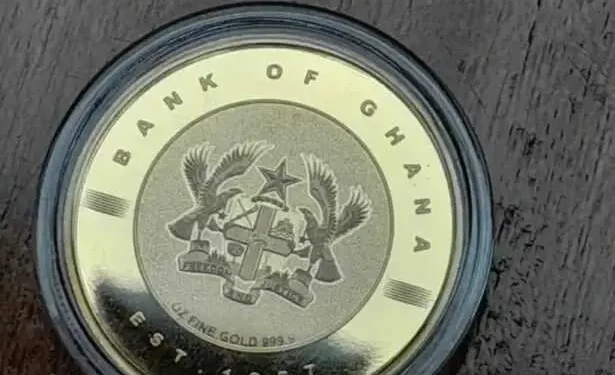
The Bank of Ghana has priced the one-ounce Ghana Gold Coin at GHS 50,012.73 for Thursday, July 23, 2026. This significant valuation reinforces the growing role of gold-linked assets within Ghana's domestic savings market. Investors are increasingly sensitive to inflation and exchange rate risks, seeking value preservation.
The central bank's public pricing notice detailed the 1.00-ounce coin at GHS 50,012.73. The 0.50-ounce coin was priced at GHS 25,363.52, and the 0.25-ounce coin at GHS 13,062.49. The Bank of Ghana based this pricing on the previous day's LBMA PM gold price of US$4,155.10 and the Bloomberg REGN USD/GHS rate of 11.6150.
This development places Ghana's gold coin programme at the centre of a wider economic conversation. It explores whether domestic access to gold can offer households and institutions a credible hedge against currency uncertainty. It also raises questions about whether it risks becoming an investment window accessible mainly to wealthier savers. The gold coin's price reflects both international bullion prices and the local cedi exchange rate, as gold is priced globally in US dollars but sold locally in cedis.
Using the Bank of Ghana’s stated LBMA PM price and exchange rate, the cedi equivalent of one ounce of gold works out at roughly GHS 48,261.49 before other pricing factors. The official 1.00-ounce gold coin price of GHS 50,012.73 therefore implies a margin of about 3.63% over the simple spot-equivalent calculation. For the 0.50-ounce coin, the implied margin is about 5.11%, while the 0.25-ounce coin carries an implied margin of about 8.26%. This pattern is common in physical bullion products, where smaller denominations often have higher per-ounce equivalents due to minting and distribution costs.
For local investors, this means smaller coins are more expensive per ounce. This matters because the Ghana Gold Coin is positioned in a market where savers remember recent macroeconomic volatility. Inflation has eased from previous highs, but purchasing power erosion remains a concern. The cedi has also experienced sharp movements, making gold attractive for investors seeking a stable store of value.
The Bank of Ghana’s gold coin pricing provides a market reference point for converting international bullion value into a domestic investment product. It creates a local price signal for gold ownership outside traditional channels like jewellery or informal bullion. This is important for financial deepening, offering an alternative savings instrument and supporting the formalisation of gold-related investment demand. It may also help households diversify savings beyond bank deposits, Treasury bills, property, and foreign currency.
However, the policy challenge is significant. At GHS 50,012.73 for the 1.00-ounce coin, the product is beyond the reach of many ordinary wage earners. Even the 0.25-ounce coin, priced at GHS 13,062.49, requires substantial liquidity. This suggests the gold coin is a domestic savings instrument, but not yet a mass-market financial inclusion product. The Bank of Ghana faces a delicate balance in its objectives.
If the gold coin is mainly a store-of-value product for high-net-worth individuals and institutions, it serves a useful market function. However, if policymakers intend it to be a broad alternative to dollarisation or informal gold buying, accessibility will be crucial. The question of liquidity is also important. For any gold coin programme to gain credibility, investors must be confident they can both buy and sell the coin transparently and at a fair price when needed. The Bank of Ghana notice suggests a two-way market reference, but the actual depth and ease of trading will evolve over time.