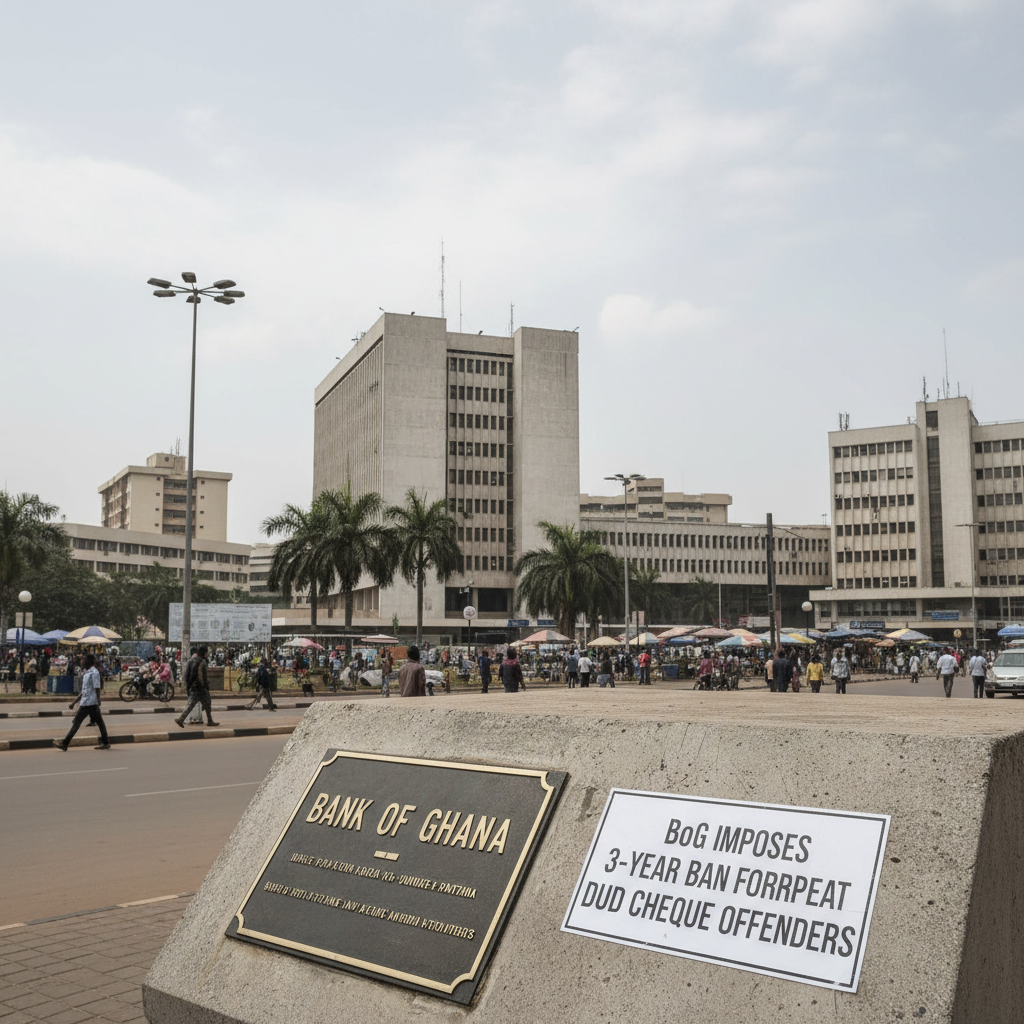
The Bank of Ghana (BoG) has announced that individuals who repeatedly issue dud cheques, also known as bounced cheques, now face a three-year ban from accessing new cheque books and credit facilities. This updated directive, issued on June 24, 2026, aims to curb the prevalent issue of dishonoured cheques across the banking system.
The central bank stated that affected individuals will be denied new credit facilities from all banks and Specialized Deposit-Taking Institutions (SDIs). Despite the ban, customers can still receive funds into their accounts and perform other electronic transactions. This new rule addresses a significant challenge undermining public confidence in cheque payments.
This move fits into Ghana's broader economic strategy to strengthen financial system integrity and consumer trust. The high incidence of dud cheques has been a persistent concern, prompting the BoG to reinforce its regulatory framework. Previous directives in March 2021 and October 2025 did not fully resolve the problem, necessitating these stricter measures for financial stability.
The BoG clarified its concerns, stating that it has "observed with grave concern the high issuance of dud cheques by some customers of Banks and Specialized Deposit-Taking Institutions (SDIs)." This development has negatively impacted the acceptance and reliability of cheques as a payment method in Ghana. The central bank plans to publish the names of customers who become third-time offenders.
As part of the revised framework, banks and SDIs must impose a levy of 10% of the dud cheque's face value for a first-time offence. They must also issue a warning to the customer. This offence will be reported to Credit Reference Bureaus and the Bank of Ghana. The customer will then be placed under surveillance for at least one year.
For a second offence within one year of the first, a levy of 15% of the cheque's face value applies. Banks and SDIs must also issue another warning. These notifications can be sent via SMS, email, or other established communication channels. The notification must clearly outline the further sanctions for repeated offences.
Customers who fail to return unused cheque books within ten working days of being notified about a ban will face additional penalties. They will be restricted from operating current accounts and placed on a high-risk list of cheque issuers. The Bank of Ghana will maintain this list to ensure compliance and deter future violations.
Reporting obligations have also been reinforced for financial institutions. Banks and SDIs must continue submitting data on dud cheque issuers to Credit Reference Bureaus. This is in accordance with Section 25(c) of the Credit Reporting Act, 2007 (Act 726). Monthly returns on dud cheques must be submitted to the Bank of Ghana by the 10th day of the following month.
Failure to submit these returns, or the submission of inaccurate or incomplete data, will incur sanctions. These penalties fall under Section 93 of the Banks and Specialised Deposit-Taking Institutions Act, 2016 (Act 930). This comprehensive approach underscores the BoG's commitment to maintaining a robust and trustworthy payment ecosystem.