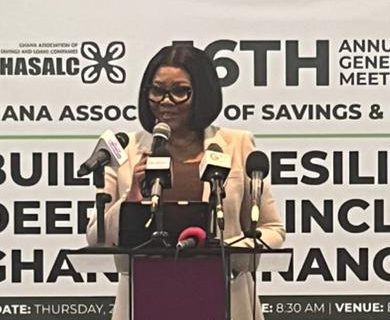
The Bank of Ghana (BoG) has mounted a forceful defence of its planned overhaul of the microfinance and specialised deposit-taking institutions sector. The central bank argues that stronger capital, tighter governance, and a less fragmented market structure are necessary to rebuild confidence and create institutions capable of surviving future economic shocks.
Mrs. Matilda Asante-Asiedu, Second Deputy Governor of the Bank of Ghana, stated the reforms are not merely about tougher regulation. Instead, they represent an attempt to strengthen the institutional foundations of financial inclusion. This includes safeguarding a financial system segment that serves Small and Medium-sized Enterprises (SMEs), women, young people, and communities often overlooked by conventional banking.
Ghana’s financial sector has shown resilience after navigating the banking sector clean-up and the Domestic Debt Exchange Programme. However, vulnerabilities remain that require structural intervention, according to Mrs. Asante-Asiedu. This reform aims to rebuild public confidence and trust, deepening financial inclusion for the unbanked, SMEs, women, and youth. It also seeks to strengthen local participation and ownership, building a financial system capable of sustaining Ghana’s growth for the next generation.
Speaking at the 16th Annual General Meeting of the Ghana Association of Savings and Loans Companies in Accra, Mrs. Asante-Asiedu framed the reform debate. She placed it squarely at the intersection of financial stability and financial inclusion. The institutions affected by the reforms occupy a difficult but important position in Ghana’s financial architecture. They often serve customers whose businesses are too small, too informal, or too costly for conventional banks to serve efficiently.
Reforms designed to make institutions safer can also create risks. This happens if the transition becomes too expensive, too abrupt, or too concentrated. Mrs. Asante-Asiedu acknowledged these concerns. However, she argued that Ghana’s own regulatory history supports the case for stronger standards. She referenced successive waves of reform in the banking sector from the 1980s through the 2000s. These included new licensing requirements, revised capital thresholds, stronger corporate governance, and more rigorous supervision.
The Bank of Ghana’s reform strategy rests on three main pillars: capital, governance and risk management, and institutional restructuring. On capital, the central bank’s position is that stronger buffers should be understood as protection against economic volatility. They are not arbitrary regulatory hurdles. Revised capital requirements will ensure institutions can absorb losses from economic shocks. This allows them to continue serving customers through periods of uncertainty. Financial institutions operating with weak capital positions have less capacity to withstand loan losses, liquidity shocks, or macroeconomic stress. When losses emerge, pressure can quickly move from shareholders to depositors, creditors, and ultimately the wider financial system.
However, the trade-off is equally real. Raising capital requirements can force institutions to seek new shareholders, retain more earnings, consolidate, merge, or exit the market altogether. For large institutions, these adjustments may be manageable. For smaller specialised lenders serving lower-income customers, they may be considerably more difficult. This is where the financial-inclusion risk begins. If stronger capital rules produce fewer but healthier institutions, the reform may strengthen financial stability. But if the resulting institutions become more urban, more risk-averse, or more expensive, customers in smaller communities could find themselves with fewer financing options. The success of the reforms will therefore depend not only on whether balance sheets become stronger, but also on whether the resulting system continues to reach the customers it is meant to serve. Mrs. Asante-Asiedu appeared conscious of that tension, reiterating the indispensable role these institutions play in reaching youth, women, and community members.