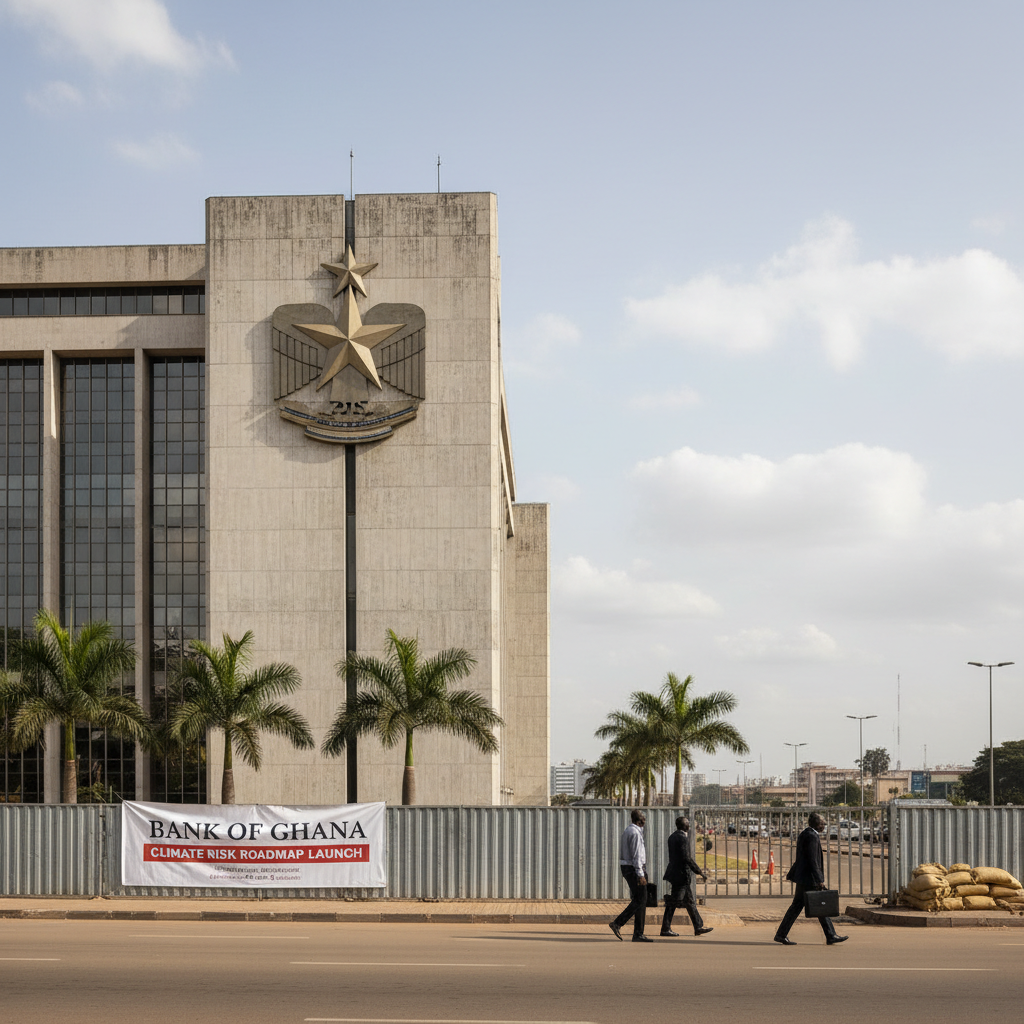
The Bank of Ghana (BoG) launched a national Sustainable Finance Roadmap this week. This new framework aims to coordinate financial sector regulation, strengthen resilience to climate-related risks, and attract global capital for climate and sustainable development projects.
This initiative follows recent flooding in Accra that claimed about 17 lives. BoG Governor Dr. Johnson Pandit Asiama stated the roadmap marks a shift from fragmented sustainability efforts. It establishes a unified regulatory approach across banking, insurance, pensions, and capital markets. Climate-related risks have become increasingly important to financial stability.
This development fits into Ghana's broader economic story of managing environmental challenges. It also seeks to position the country to attract foreign direct investment in green sectors. Prior efforts include the 2019 Sustainable Banking Principles, voluntarily adopted by all 23 commercial bank chief executives. These principles integrate sustainability into governance, risk management, and business operations.
BoG Governor Dr. Johnson Pandit Asiama emphasized that climate change is no longer just an environmental issue. He stated it is a financial risk affecting asset values, insurance claims, and lending decisions. “Recent flooding illustrates how climate shocks can quickly transmit into financial markets, requiring regulators to rethink supervision, risk pricing and long-term planning,” Dr. Asiama said.
The roadmap creates a common framework for Ghana’s financial regulators to coordinate sustainable finance policies. It has three core pillars. First, it integrates environmental, social, and governance (ESG) principles into financial decisions. Second, it strengthens climate-related financial risk management. Third, it expands financing for sustainable development.
The framework assigns clear implementation responsibilities to participating regulators. This moves beyond general policy commitments towards measurable actions. These actions aim to improve risk management and create new investment opportunities. The roadmap also mobilises private and institutional capital through green and blended finance. This supports the country’s energy transition and deepens domestic financial markets. Ultimately, it positions Ghana as a regional sustainable finance hub.
In 2015, the BoG established the Sustainable Banking Principles Steering Committee. This committee included the Ghana Association of Banks and the Environmental Protection Agency. BoG then introduced a compliance assessment framework in 2021. This was supported by the International Finance Corporation (IFC) and the Swiss State Secretariat for Economic Affairs (SECO).
Financial institutions and investors will likely adapt their strategies to align with these new regulations. They will seek to identify and mitigate climate-related risks in their portfolios. The roadmap's success will depend on effective coordination among regulators. It will also rely on strong private sector participation in green investments. This initiative could unlock significant funding for Ghana's sustainable development goals.