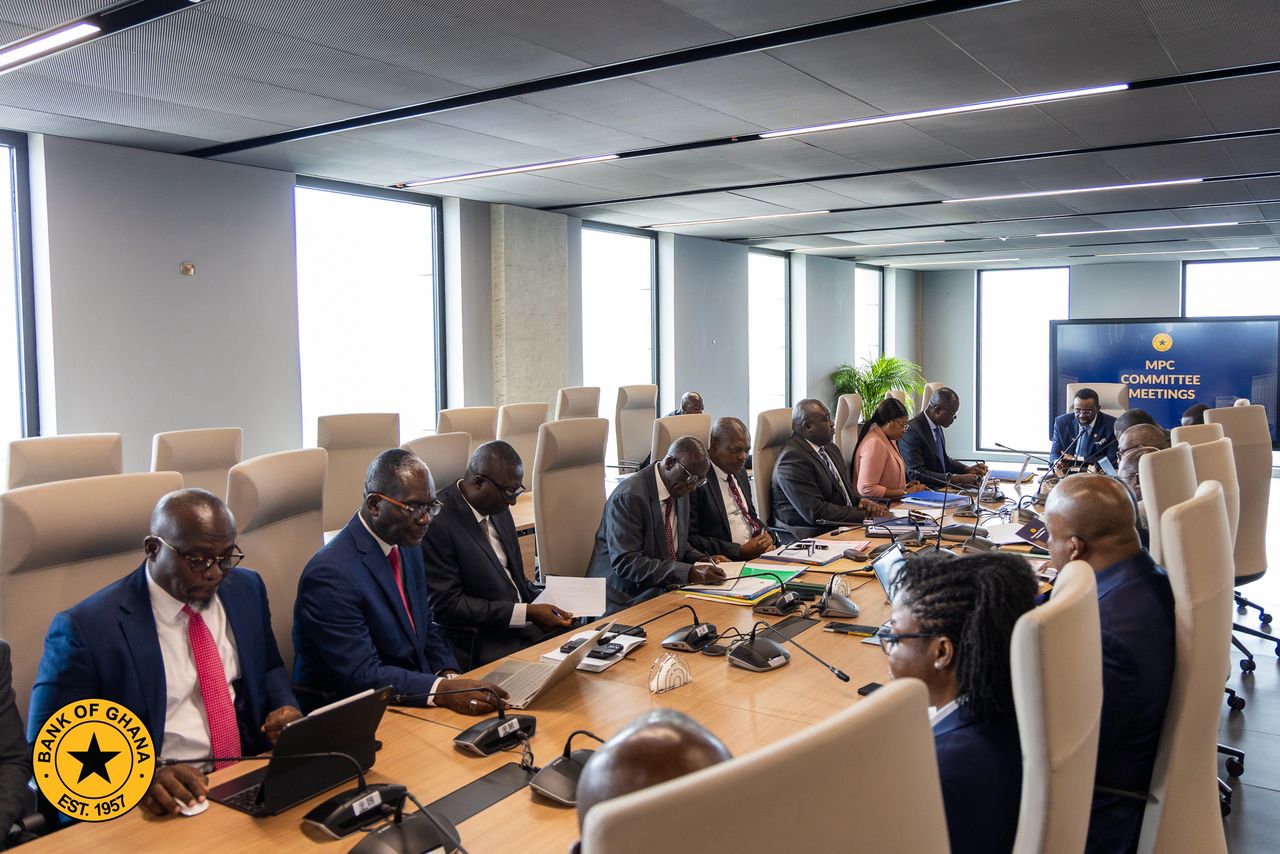
The Bank of Ghana’s Monetary Policy Committee (MPC) has kept its benchmark policy rate unchanged at 14.00% following its 131st meeting. This decision comes despite a recent increase in Ghana’s inflation rate, indicating the central bank’s reluctance to immediately tighten monetary policy.
The MPC’s stance is a “hawkish hold,” meaning the rate remains stable, but the Bank of Ghana (BoG) is prepared to increase it if rising costs for fuel, transport, and utilities lead to broader and more lasting inflation. NorvanReports estimates a 70.00% probability of the rate remaining at 14.00%, with a 25.00% chance of a 100-basis-point increase to 15.00%.
This decision is crucial for Ghana’s economic stability, as the central bank navigates between supporting growth and controlling price increases. The country has seen inflation rise for three months in a row, from 3.20% in March to 5.30% in June. However, this figure is still below the BoG’s medium-term target range of 8.00%, plus or minus 2.00 percentage points, and significantly lower than the 13.70% recorded in June 2025.
Governor Dr. Johnson Pandit Asiama’s remarks suggest the Committee is not viewing the latest inflation rise as an automatic trigger for higher interest rates. Instead, the Bank is trying to determine if inflation is undergoing an “orderly normalisation” or entering a more persistent phase. This distinction is vital because central banks typically only raise rates when inflation threatens to become widespread or shift public expectations.
The June inflation data presents mixed signals. Non-food inflation increased to 6.30%, and core inflation, which excludes volatile items like energy and food, also accelerated. Core inflation, excluding energy, utilities, and volatile food, rose to 6.40%, while the measure excluding energy, utilities, and all food items reached 7.10%. These figures suggest that price pressures might be spreading beyond initial shocks in transport and energy.
However, monthly headline inflation in June was only 0.20%, a decrease from 1.10% in May. Food inflation also slowed to 0.10% month-on-month. These monthly figures suggest that the annual rate acceleration is not yet accompanied by an uncontrolled surge in prices each month.
Producer price developments also support the decision against an immediate rate hike. National producer inflation stood at 3.50% in June, down from 5.80% a year earlier. Producer prices also fell by 3.70% compared to May. The industry, excluding construction, recorded a year-on-year inflation of 3.30% and a month-on-month decline of 4.20%.
Despite these broader trends, some sectors show concentrated pressure that could affect consumer prices. Electricity and gas producer inflation rose to 12.50%, transportation and storage reached 10.00%, and accommodation and food-service activities increased sharply to 10.80%. These are the areas the Governor has highlighted as potential concerns.
The Committee is carefully assessing the combined impact of imported energy costs, potential utility-tariff adjustments, and transport-fare increases. The risk is that a temporary external shock could become embedded in the domestic economy through higher operating costs, wage demands, and repeated price adjustments.
The foreign exchange market also presents a reason for caution. The Ghana cedi was quoted at GHS 11.55 to the US dollar as of July 17, representing a year-to-date depreciation of 9.50%. While the currency’s movement has been relatively orderly, continued depreciation could worsen imported inflation, especially if global oil prices remain high. Brent crude averaged US$84.10 per barrel in June, 36.50% above its end-2025 level. Renewed tensions around the Strait of Hormuz have pushed Brent above US$85, increasing the risk of higher domestic fuel and transportation costs.
A policy rate increase would also face a significant transmission problem. The interbank weighted average rate was 10.24% in June, which is considerably below the 14.00% policy rate. The 91-day Treasury bill rate was 5%.