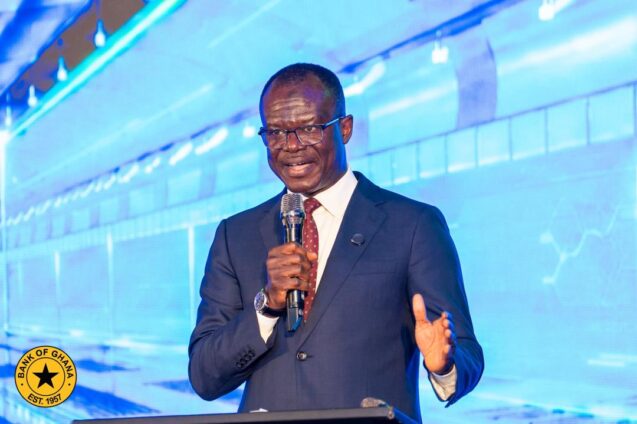
The Bank of Ghana (BoG) has deployed Artificial Intelligence (AI) to strengthen its inflation forecasting and improve economic data gathering. This strategic move aims to provide more accurate information for critical monetary policy decisions. First Deputy Governor Dr. Zakari Mumuni confirmed this development, highlighting the central bank's commitment to modernizing its analytical capabilities.
Dr. Mumuni stated that AI is part of the BoG's wider adoption of advanced modelling tools and big data technologies. These tools are already helping the Bank improve its forecasts, including predictions made before official data releases. The enhanced accuracy in inflation predictions is vital for maintaining price stability and supporting Ghana's economic growth trajectory.
This technological advancement fits into Ghana's broader economic narrative of leveraging innovation for better governance and financial stability. The BoG's proactive stance on inflation management, as charged by the Governor in February 2025, underscores the importance of timely and precise economic intelligence. This initiative aligns with global trends where central banks increasingly use technology to navigate complex economic landscapes and respond effectively to market dynamics.
“We also employ machine-learning models to complement standard econometric models in forecasting GDP and performing text-mining analytics,” Dr. Mumuni explained. He made these remarks at the 4th Annual Statistics and Data Science Conference in Tamale. He emphasized that technology also transforms financial supervision, allowing for earlier identification of risks through granular data validation.
The implications of this AI deployment are significant for Ghana's financial markets and economic outlook. More accurate inflation forecasts can lead to better-informed interest rate decisions, impacting borrowing costs for businesses and consumers. Investors and businesses will watch for how these improved insights translate into more stable economic conditions and predictable policy responses from the central bank. The BoG's ability to process and analyze large volumes of data more efficiently should enhance its responsiveness to economic shifts.
Dr. Mumuni also noted that the Bank uses econometric techniques and its Quarterly Projection Model to assess economic developments. This system helps identify emerging trends, evaluate risks, and consider potential outcomes of various policy choices. The integration of AI complements these existing robust analytical frameworks, creating a more comprehensive and dynamic approach to economic analysis.
Despite the advanced technology, Dr. Mumuni cautioned that human judgment remains irreplaceable in economic policymaking. Technology strengthens intelligence but does not remove the need for expert human decisions. This balance between advanced tools and human expertise is crucial for effective policy implementation and avoiding potential pitfalls of over-reliance on algorithms.
The First Deputy Governor reiterated the challenge facing policymakers: transforming abundant data into timely, reliable, and actionable intelligence. He stressed that data alone does not formulate policy; it requires careful interpretation and strategic application. This perspective ensures that the AI tools serve as powerful aids rather than sole decision-makers.
Furthermore, the BoG continues its traditional data collection methods, with Research Department staff tracking prices and conducting surveys across Ghana. This ensures that policy decisions reflect the country's diverse economic experiences, not just those of Accra. Dr. Mumuni urged statisticians to ensure new technologies complement sound statistical methods, advocating for a collaborative approach between researchers and policymakers.
This comprehensive approach, combining cutting-edge AI with traditional data gathering and human oversight, positions the Bank of Ghana to enhance its role in maintaining economic stability. The move is expected to improve the central bank's ability to anticipate economic challenges and implement timely interventions, benefiting the wider Ghanaian economy and its citizens.