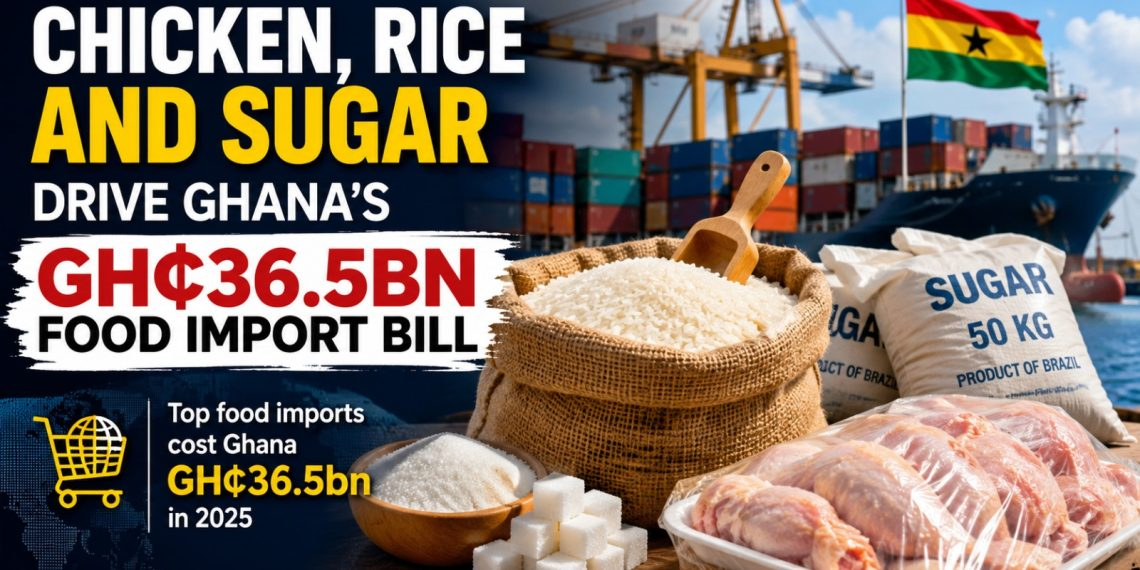
Ghana's Food Import Bill Reaches GHS 36.5 Billion in 2025

    Cereal grains, frozen chicken, and animal products drive significant reliance on external markets.

    2 min read3 min listen
    Ghana's Food Import Bill Reaches GHS 36.5 Billion in 2025
    Ghana spent GHS 36.5 billion on food imports in 2025, a significant expenditure driven primarily by cereal grains, frozen chicken, and various animal products. The Annual International Merchandise Trade Statistics Report from the Ghana Statistical Service (GSS) confirmed this figure, indicating a total food import value of GHS 36.46 billion. This substantial reliance on external markets meets the country's demand for essential food commodities. The high import bill underscores Ghana's continued dependence on foreign food supplies. Processed cereal grains alone accounted for GHS 2.94 billion, representing 8.1 percent of all food imports. Frozen chicken imports were close behind at GHS 2.84 billion, while animal guts, bladders, and stomachs contributed GHS 2.72 billion. These categories, along with rice, form a major part of the nation's food import expenditure. This trend fits into Ghana's broader economic narrative of balancing agricultural potential with import dependency. While Ghana benefits from exporting value-added agricultural products like cocoa and cashew nuts, it simultaneously relies heavily on foreign sources for staple foods. This situation presents both opportunities for growth in domestic agriculture and challenges in achieving food security and reducing trade deficits. The Ghana Statistical Service highlighted the need for strategic interventions to address this imbalance. They noted that increasing domestic production, expanding agro-processing capabilities, and promoting value addition are crucial steps. These measures aim to reduce the country's reliance on imported food and strengthen the overall resilience of the agricultural economy. The implications of this rising import bill are far-reaching. A high food import bill can strain Ghana's foreign exchange reserves and contribute to inflationary pressures. It also exposes the country to global price volatility and supply chain disruptions, impacting food security for its citizens. Policymakers will likely face increased pressure to accelerate initiatives aimed at boosting local food production and supporting farmers. Ghana's agricultural sector has shown growth potential in exports, particularly with processed cocoa products, cashew nuts, tuna, and shea-based items. These exports contribute significantly to the country's earnings. However, the persistent need for imported staples indicates a structural challenge within the domestic food supply chain that requires urgent attention. The government's 'Planting for Food and Jobs' initiative, for example, aims to address some of these issues by promoting local farming. Addressing the food import challenge will require a multi-faceted approach. This includes investing in modern farming techniques, improving storage and transportation infrastructure, and providing financial support to local farmers. Encouraging local consumption of domestically produced goods through public awareness campaigns could also play a role. The GSS data serves as a critical benchmark for evaluating the effectiveness of current and future agricultural policies. The nation's economic stability and food independence hinge on successfully reducing this import dependency.

    Comments

    More from StatsGH