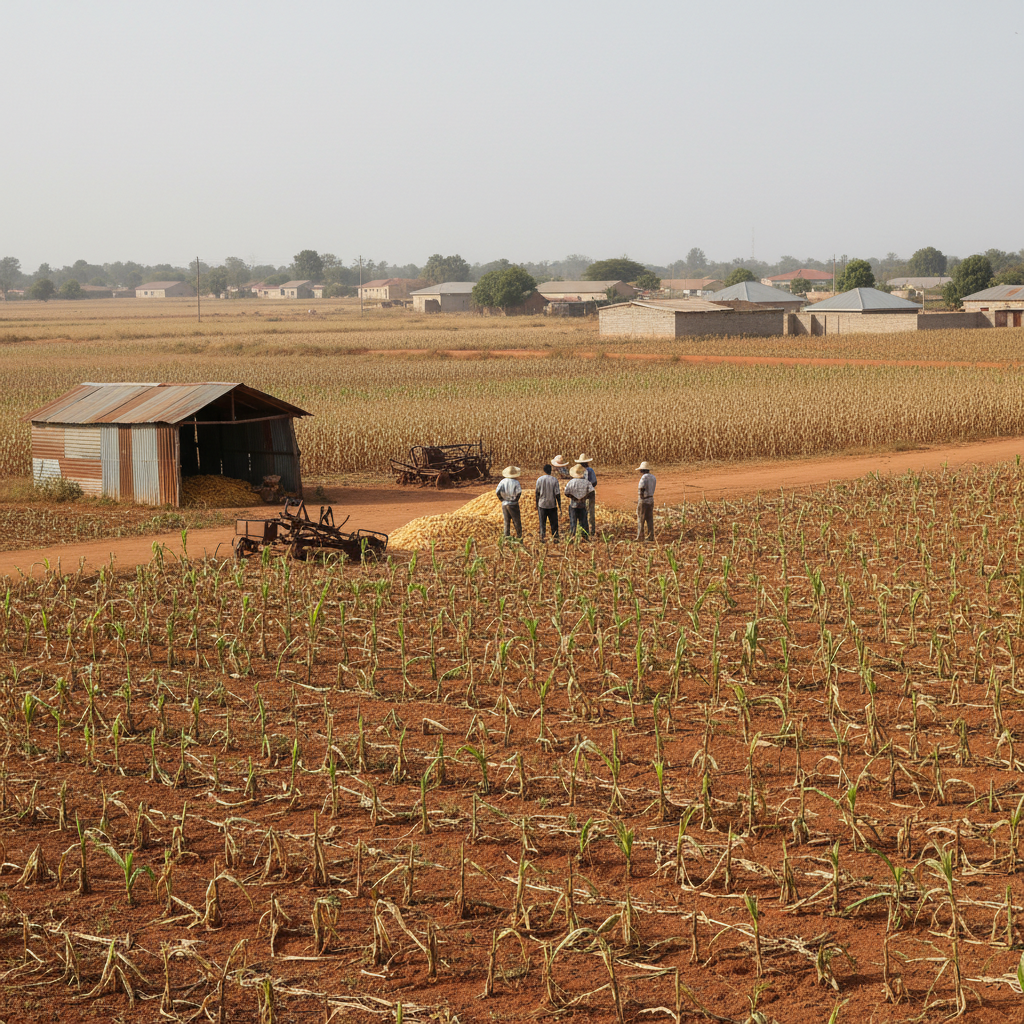
Many Ghanaian farmers, particularly new entrants, are experiencing significant financial losses and often fail within three crop cycles because they base their operations on motivation rather than sound business analysis. This critical lack of financial planning is leading to substantial economic setbacks for individuals entering the agribusiness sector.
These failures occur because farmers frequently disregard essential financial data, such as production costs, potential market price fluctuations, and risk management strategies. Inspirational stories and self-help advice often overshadow the need for detailed cost structures and cash flow plans. This oversight leaves farmers vulnerable to unexpected challenges like pest infestations or price volatility, which can quickly erase any projected profits and lead to business closure.
This trend highlights a broader issue within Ghana's agribusiness community, where an emotional narrative often dominates the practical aspects of farming. Data from numerous failed ventures indicate a systemic problem where enthusiasm replaces rigorous economic scrutiny. The reliance on motivation over numbers prevents the sector from achieving its full potential for wealth generation and sustainable growth, impacting national food security efforts and rural economic transformation.
Kelvin Essuman Quansah, Enterprise Development Manager at Agri Impact Limited, emphasized the market's indifference to farmer motivation. He stated, “The market woman will not ask about your motivation. She will ask about your price. And if your numbers are wrong, no amount of motivation will save your farm.” This underscores the harsh reality that market forces, not personal drive, dictate profitability in agribusiness.
To mitigate these financial pitfalls, farmers must adopt a business-centric approach, meticulously analyzing their costs and potential revenues before planting. This includes understanding fixed costs, which remain constant regardless of production volume, and variable costs, which fluctuate with output. Farmers who embrace financial planning are better equipped to navigate market challenges and build resilient, profitable agricultural enterprises. Market participants and financial institutions will increasingly scrutinize business plans based on solid financial projections rather than mere optimism.
A detailed financial breakdown of a typical 340m² greenhouse tomato operation in Ghana reveals the importance of such planning. Under ideal conditions, a single crop cycle could yield 2,000 kg of tomatoes, sold at GHS 25.00/kg, generating a total revenue of GHS 50,000. With an estimated total cost of production at GHS 31,000, this leaves a net profit of GHS 19,000, representing a 38% net margin.
However, this seemingly strong margin quickly erodes under real-world conditions. For example, a moderate pest infestation could reduce the yield by 40%, plummeting it to 1,200 kg. This would cut revenue to GHS 30,000. Even with a 30% reduction in variable costs, fixed costs of GHS 16,000 for greenhouse loan repayments and core labour remain unchanged. This scenario results in a collapsed net profit of GHS 21,700, reflecting a significant financial strain.
Furthermore, a market price drop to GHS 20.00/kg, common during peak supply periods, pushes the farming operation into an even more precarious position. Under these combined adverse conditions, the net profit dwindles to GHS 2,300, nearing a complete financial loss. Farmers who fail to model such scenarios are ill-prepared for inevitable market and environmental variabilities.
The market woman, a key player in the supply chain, acts as a clear signal of market realities. She evaluates supply and demand with precision, knowing when excess produce from sources like Burkina Faso enters the market or when local harvests are abundant. Her pricing decisions are based purely on market dynamics, not on a farmer’s individual production costs or financial commitments.
If a farmer’s cost of production is GHS 20/kg and the market offers GHS 15/kg, the farmer faces difficult choices: accept the financial loss, risk further deterioration of produce by holding it, or seek alternative buyers. The absence of pre-established commercial relationships and diversified market channels, which result from informed business planning, leaves farmers vulnerable. These situations underscore that farming is fundamentally a business driven by margins, not by motivation alone.