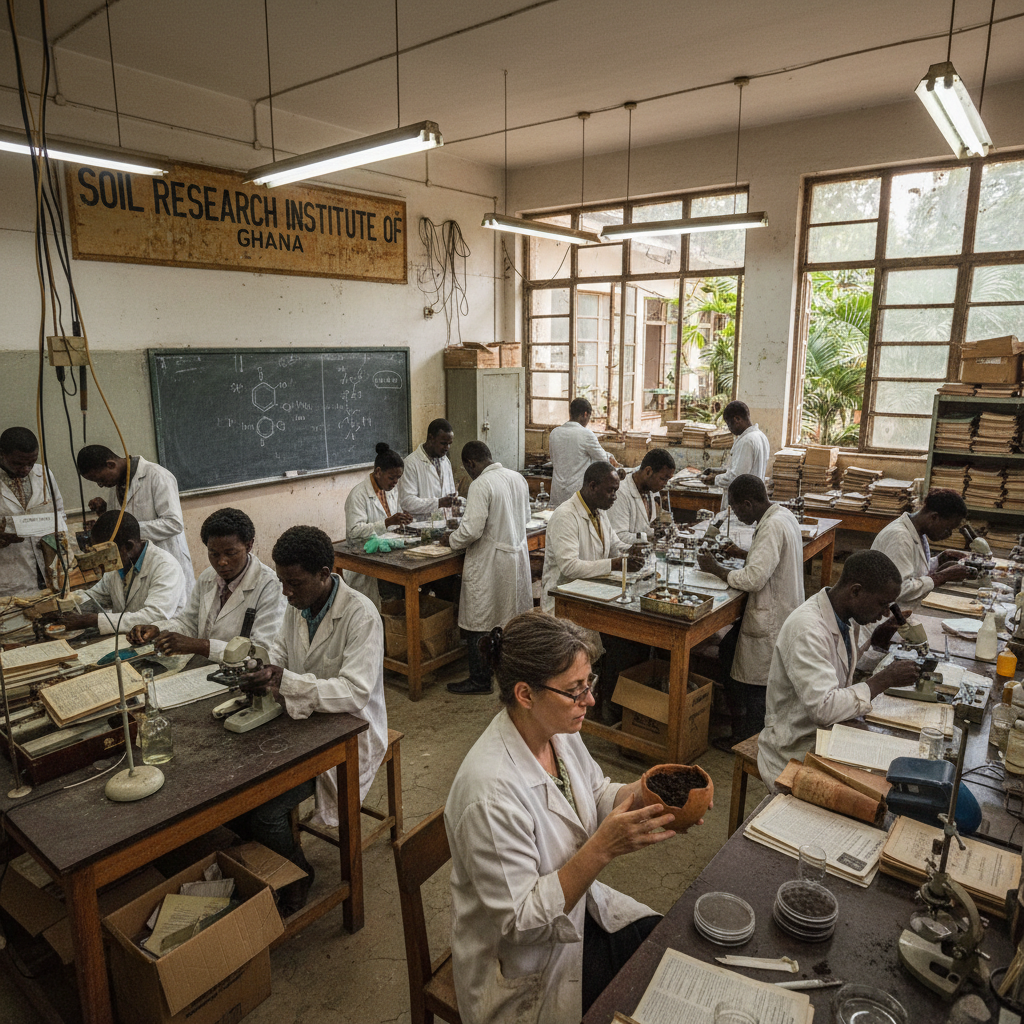
The Council for Scientific and Industrial Research (CSIR) Soil Research Institute operates with zero direct government funding for its crucial research activities. Dr. Collins Tay, the Institute’s Director, states that this situation severely jeopardises Ghana’s capacity to create evidence-based solutions for food production.
Dr. Tay explained that the government covers staff salaries, but no funds are provided for field research, sample collection, soil analysis, or project execution. All current research relies entirely on external donor funding. This reliance on outside sources raises serious questions about Ghana’s control over its strategic agricultural data.
This funding gap comes as Ghana aims to strengthen its agricultural sector. Consistent investment in research institutions is vital for developing local solutions to boost productivity. The nation's ability to modernise agriculture and reduce food imports depends on this domestic research capacity. Data from the Ghana Statistical Service shows that agriculture contributes significantly to the country's Gross Domestic Product.
Dr. Tay highlighted the institute's critical role in providing essential soil fertility information. It also conducts land suitability assessments and agricultural mapping services. These services guide crop production decisions across Ghana. The institute developed the Ghana Soil Information System. This digital platform helps farmers identify suitable crops and fertiliser needs based on specific soil types.
"We have zero funding of our research. Government pays our salaries, yes . . . but when it comes to actual research . . . there is no government money for that," Dr. Tay stated. He added, "Everything we do in terms of research is donor-funded." This means that pivotal research, aimed at increasing agricultural yields and ensuring food security, lacks direct national investment.
The increasing dependence on donor funds presents significant long-term risks for Ghana. Dr. Tay warned that current funding agreements often require the transfer of raw data to external partners. This model differs from previous arrangements where research institutions retained data ownership. "The funders want the raw data . . . ownership and control of that data can end up outside the country," he explained.
This trend could mean critical national soil information falls into foreign hands. Ghanaian scientists might lose the ability to independently conduct future research. Such a situation would limit Ghana's capacity to develop its own agricultural solutions. It could also force Ghana to pay for its own data in the future.
Dr. Tay cautioned that blindly applying fertiliser wastes financial resources. Ghana spends considerable amounts importing and subsidising fertilisers for farmers. However, the lack of research funding means the country does not invest in understanding specific fertiliser needs. "We are not investing in the research that tells us which fertiliser is needed where," he noted.
Failure to address this funding shortfall could have severe consequences for national development and food security. Dr. Tay predicted a dangerous future if the situation continues. "In the next 10 or 15 years, all our soil data systems will be in the hands of external partners," he warned. This prospect underscores the urgency for immediate government intervention to secure Ghana's agricultural future.